

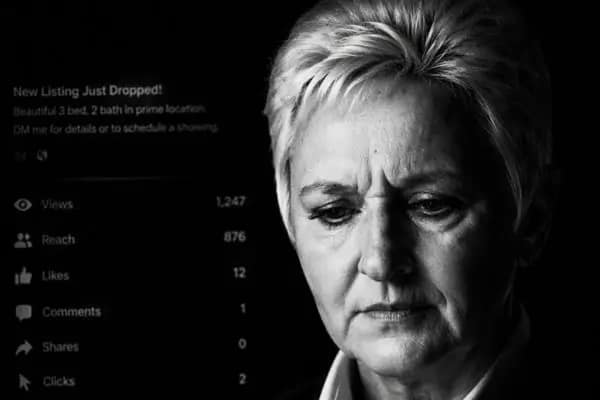
The answer has nothing to do with your content and everything to do with what is missing behind it.
You post. You show up. You stay consistent for weeks, sometimes months.
And then nothing happens.
No calls. No DMs from serious buyers. No listing appointments from people who saw your content and decided you were the one.
So you start questioning everything. Was it the caption? The timing? The hashtags? Maybe you need better photos. Maybe you need to post more. Maybe you need to try a different platform.
Here is the reality: why real estate agents posting on social media and still get no clients has almost nothing to do with the content itself. It has everything to do with what is missing behind it, the system, the strategy, and the positioning that turns visibility into authority.
Key Takeaways
- Posting creates activity, not authority. Without a positioning system behind your content, you are producing noise, not recognition.
- Most agents are chasing the 3 percent of the market ready to transact right now. The 97 percent who will eventually buy or sell are where long-term business is built.
- Trustworthiness is the deciding factor when a buyer or seller chooses an agent. Sporadic posts do not build it. Repeated, consistent presence over time does.
- Visibility and system must work together. One without the other fails.
- The agents who win are not posting the most. They are the ones their market already knows before anyone is ready to move.
Table of Contents
The Problem Is Not Your Posts
Why real estate agents posting on social media and still get no clients? Let’s look at what you have done.
You created content. You showed your listings, your closings, maybe your community. You posted tips. You went live a few times. You did what you were told social media was supposed to do for your business.
And the results were thin. Maybe a few likes from colleagues. A comment from your mom. An occasional “great post!” that went nowhere.
Here is the diagnosis: the content is not the constraint. The constraint is the absence of a system around the content.
Ninety percent of realtors use Facebook. Fifty-two percent are on Instagram. Sixty-three percent are already using video in their social media marketing. These are not fringe behaviors (they are industry) wide practices. And yet, most of those agents are not building market authority from that activity. They are just adding to the noise.
Why? Because posting is an action. Authority is a result. And the two are not automatically connected.
The connection requires positioning. It requires strategy. It requires a system that takes the attention your content earns and turns it into trust that compounds over time.
Without that, you are producing content that disappears the moment someone scrolls past it.
The Misunderstanding That Costs Agents the Most
Most agents approach social media as a lead generation channel. Post something compelling enough, get a DM, close a deal.
That thinking has a fundamental flaw in it.
People do not choose real estate agents based on a single post. They choose based on recognition, familiarity, and trust built over time. Trustworthiness and honesty rank as the top qualities buyers and sellers look for in an agent, far ahead of any other factor. Local market knowledge comes in second. But neither of these things is communicated by a listing announcement or a market stats graphic.
Trust is not a moment. It is a pattern.
The agents who get called when someone is ready to move are not the ones who posted the best content last Tuesday. They are the ones the buyer or seller already knows. Already recognizes. Already trusts, before the conversation about real estate even starts.
This is what I call the 97 percent problem.
At any given time, roughly 3 percent of your market is ready to buy or sell right now. These are the people actively searching, actively interviewing agents, actively ready to transact. Every agent in your market is chasing them. That is where all the competition lives.
The other 97 percent are not ready yet. They are thinking about it, eventually. They will sell in two years, or three, or five. They are watching. They are forming opinions about which agent seems credible. They are noticing who shows up consistently and who disappears.
Most agents ignore this group entirely. Their content is designed to capture the 3 percent. Calls to action built around immediate moves, urgency language, “ready to sell? call me now.”
And the 97 percent watches. Forms no opinion. And when they are finally ready, they call the agent who has been showing up in their world consistently, not the one who happened to post at the right moment.
Social media, when used correctly, is a tool for building presence with that 97 percent. But only when there is a system behind it.
Why Visibility Without System Fails
Here is a pattern that plays out constantly in this industry.
An agent commits to social media. Posts consistently for sixty days. Gets some engagement. Starts to build a small audience. Then a busy market hits, or a few closings happen, or life gets in the way and the posting stops.
The moment it stops, the building stops.
And then they restart. Post again for a few weeks. Stop again.
This is not a consistency problem. It is a system problem. Without a system, content creation depends on motivation, energy, and available time, all of which are unpredictable. With a system, content is a scheduled, structured output that happens regardless of what else is going on in the business.
But even consistent posting without positioning strategy produces limited results.
Posting the same content as every other agent in your market (just listed, just sold, market update, motivational quote) tells the market nothing that separates you. It signals that you are a competent agent. So does everyone else in your feed.
Positioning is the difference between being one of many competent agents and being the obvious choice in a specific market or niche. It is what makes someone think of you first, specifically, when the time comes.
Real estate is one of those industries where the trust problem is acute. Real estate agents sit near the bottom of occupational trust rankings, alongside car salespeople and politicians in some surveys. That is not a reason to panic. It is a reason to understand that building trust requires deliberate, sustained effort. Not one great post. Not a viral video. A pattern of showing up as a credible, knowledgeable, consistent presence over time.
That pattern is not built by posting. It is built by a positioning system that uses posting as one component of a larger structure.
What a Positioning System Actually Does
A positioning system is not a content calendar. It is not a social media schedule. It is not a list of post types to rotate through.
A positioning system answers these questions before a single post is created:
What does your market know you for?
When someone in your area hears your name, what is the first thing that comes to mind? If the answer is “they are a real estate agent”, you do not have positioning. You have a business card.
Positioning means your name is associated with something specific. A neighborhood. A type of buyer or seller. A specific expertise. A clear point of view about the market. Something that separates you from every other licensed agent in your area.
Who are you building recognition with?
The 97 percent problem is not solved by creating content for everyone. It is solved by creating consistent, repeated visibility with a specific segment of your market, the people most likely to transact in the next one to three years.
This requires knowing who they are, where they are paying attention, and what they need to hear repeatedly to form trust in you before they ever need an agent.
What happens after someone sees your content?
Most agents have no answer to this question. Someone watches a video, maybe follows the account, and then… nothing. No structured follow-up. No nurture. No system that keeps them in the agent’s orbit until they are ready.
The content earns attention. The system converts that attention into a relationship that eventually produces a transaction.
Without the second part, the first part is just activity.
The Role of Video in a Positioning System
Video deserves specific attention here, because it is one of the few content formats that actually builds trust at scale.
Seventy-three percent of homeowners say they prefer to list with an agent who uses video. Listings with video generate significantly more qualified leads than those without. And yet, only a fraction of agents are using video consistently.
This is not about production quality. It is about presence.
When someone watches you on video (sees your face, hears your voice, observes how you explain something, how you carry yourself) they form an impression of you that static content cannot create. They start to feel like they know you. And that feeling, built over repeated viewings, is what eventually gets you the call.
Video is not a tactic. It is a trust-building mechanism. But only when it is used consistently, tied to a clear positioning strategy, and supported by a system that ensures the right people see it repeatedly.
Posting a video once, getting fifty views, and concluding that video does not work, that is not a video problem. It is a system problem.
What Needs to Change
The agents who are winning in their markets are not doing more. They are doing different.
They have stopped trying to create content that chases immediate leads and started building a system that creates recognition over time. They have identified what they stand for, who they serve, and what their market needs to hear from them on a consistent basis.
They post with purpose rather than posting for presence. Every piece of content is connected to a positioning strategy, not just a content calendar.
They have a structure that nurtures the attention they earn. When someone watches a video or engages with a post, there is a next step. A way to deepen the connection. A path from awareness to trust to conversion.
And they are patient, not because they are passive, but because they understand how decisions actually get made.
Buying or selling a home is one of the largest financial decisions most people will make. No one makes that decision based on a single post. They make it based on who they already know. Who they already trust. Who they already see as the clear choice.
The agents who have built that recognition over time do not have to convince anyone when the call comes. The decision was already made, months or years before the conversation started.
The Shift That Changes Everything
I built my work around one belief: agents should not have to become someone they are not to succeed. They do not need to be the loudest, the trendiest, or the most entertaining creator on the platform.
They need a system that aligns with how trust is actually built. With how people actually choose.
When an agent shifts from “I need to post more” to “I need to position better”, everything changes.
The content becomes purposeful. The audience becomes specific. The system turns attention into pipeline. And the 97 percent of your market that everyone else is ignoring becomes the foundation of a business that produces consistent results over time.
Posting is not the problem. The absence of positioning is.
Frequently Asked Questions
why real estate agents posting on social media and still get no clients
Engagement and authority are different things. Likes reflect whether content is relatable or entertaining in the moment. Authority is built through repeated positioning over time. If your content is getting reactions but not generating business, the gap is almost always a positioning and system problem, not a content quality problem. The market likes you. They do not yet know what you stand for or why you are the clear choice.
How long does it take for social media to generate real estate leads?
That question points to the core misunderstanding. Social media is not primarily a lead generation channel for most agents. It is a trust-building and authority-building channel. The agents who try to use it to generate immediate leads are chasing the 3 percent. The agents who use it to build recognition with the 97 percent see results over months, not days and those results compound in a way that sporadic lead chasing never does.
Should I try a different platform if my current one is not working?
Before changing platforms, diagnose why the current one is not working. The issue is rarely the platform. Platform-hopping without addressing the underlying positioning and system problems just means you will have the same results in a new place. The question to ask is not which platform, but what you stand for on any platform and what happens after someone discovers you.
What kind of content actually works for real estate agents on social media?
Content that consistently reinforces a specific positioning works. The format matters less than the message. An agent who is known as the clear expert in a specific neighborhood, market type, or buyer segment and creates content that repeatedly demonstrates that expertise, builds more authority than an agent rotating through generic post types with no underlying strategy. Clarity of position drives results far more than content variety.
Do I need to post every day to build authority on social media?
Consistency matters more than frequency. An agent posting three times per week with a clear positioning strategy and a system behind each piece of content will outperform an agent posting daily with no strategic direction. The goal is repeated, recognizable presence, not volume. Your audience should know what you stand for before they ever need an agent.
Final Thoughts on Why Real Estate Agents Posting on Social Media and Still Get No Clients
Real estate is not won in the transaction. It is won in the recognition that happens long before anyone picks up the phone.
Stop optimizing the posts. Start building the system.
Annett T. Block is a marketing strategist for real estate agents, teams, and brokerages. She helps agents build market authority through custom positioning systems that create the recognition, trust, and presence needed to be seen, known, trusted, and chosen. Annett works specifically with agents who are done chasing the 3 percent and are ready to build the 97 percent.
*Results depend on market conditions, budget, and execution; this content is not legal or financial advice. Always align your targeting and messaging with Fair Housing rules, platform ad policies, and privacy regulations for lead handling.
Author Annett T. Block
Annett T. Block is a real estate marketing strategist and licensed Florida broker. She works with real estate agents who want to stop chasing leads that die on the vine and start attracting business from people who already know them through video-first warm audience building, retargeting, and consistent market presence. She is the founder of The Digital Adopters.
Her thesis is simple: The lead isn’t dead. You asked for the conversation before they knew you.
One agent. One market. ZERO COMPETITION.
In real estate since 2008. Licensed Florida Broker since 2011. More than 2,000 agents, teams, and brokerages served. Featured in Inman News. She is the author of From Listings to Legends.