


The question “does Facebook work for real estate” is almost always asked by an agent who has experienced Facebook not working. Which means they already have half the answer. They know what it looks like when Facebook does not work. Cold leads, low conversion, expensive follow-up, conversations that stall at the trust-building stage. What most of them have never experienced is what it looks like when it does.
The two experiences are not subtle variations of each other. They are qualitatively different in ways that extend beyond conversion rates or cost per lead. When Facebook is working for a real estate agent’s pipeline, the nature of the conversations that arrive changes. The stage at which those conversations begin changes. The amount of trust-building work the agent has to do during each interaction changes. The comparison shopping the prospect does before committing changes. The speed from first contact to signed agreement changes.
None of those changes are visible in the standard metrics most agents use to evaluate Facebook campaigns. They do not show up in click-through rates or cost per lead form submission. They show up in the quality of the relationship the prospect has with the agent before the first word is exchanged, and that quality is the product of months of accumulated exposure to specific, consistent content delivered through a system that was built to produce recognition rather than immediate conversion.
This post is about what that experience looks like from the inside. What the agent notices. What the prospect does differently. What the pipeline feels like when the system is working the way it is designed to work.
Key Takeaway
Does Facebook work for real estate? Yes, when it is producing prospects who arrive at the first conversation already familiar with the agent’s specific expertise, already past the evaluation stage, and already inclined toward the agent before any direct interaction has occurred. That outcome is what Facebook is designed to produce when the system is built correctly. It is not what happens from a 30-day lead form campaign. It is what happens from six to twelve months of consistent recognition-building infrastructure operating in the background.
Table of Contents
What the Agent Notices First
The first sign that a Facebook system is working correctly is not a spike in lead volume. It is a change in the quality of the messages that start coming in.
The prospect messages the agent’s Facebook page and says they have been watching the videos and had a question. Not “I saw your ad”, that is cold lead language, the language of someone responding to a promotional message. The language of a prospect who has been in a functioning recognition system is specific. They reference something they watched. They ask about a particular topic the agent covered. They demonstrate familiarity that a cold contact who submitted a form has not developed.
That specificity is the first observable signal that the system is working. The prospect has moved from passive awareness, having seen the agent’s content in their feed, to active engagement with that content as a source of relevant information. The transition from passive awareness to active engagement is what the retargeting layer is designed to accelerate. A prospect who has watched one video and then been retargeted with three more over six weeks is a different prospect than one who saw a single impression. The multiple exposures have produced the accumulated familiarity that changes how they experience subsequent content.
When you go to a listing appointment or a buyer’s consult with someone who already knows you from your content, they already know, like and trust you. You just bring the paperwork, and they act as if it’s already a done deal (HousingWire). That description is not an accident or an outlier. It is what consistently happens when the recognition layer has been built correctly and maintained long enough for the familiarity to accumulate to the threshold that produces that kind of first conversation.
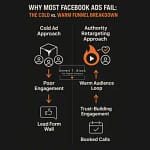
The agent who has only experienced Facebook not working has only experienced the absence of that recognition layer. They ran campaigns that produced cold form submissions, followed up with strangers who had no prior relationship with them, and experienced the low conversion rates that cold contacts reliably produce. The recognition layer was never built because the system was never structured to build it.
What the Prospect Does Differently
The prospect who arrives through a functioning Facebook recognition system behaves differently from a cold lead at every stage of the interaction. The differences are consistent enough that agents who have made the transition from a cold-lead Facebook approach to a recognition-based one describe them in remarkably similar terms.
The first difference is in how the prospect initiates contact. Cold leads almost always contact the agent reactively, in response to a direct prompt. A retargeted ad with a call to action, a follow-up email that finally got a response, a phone call that happened to catch them at the right moment. The inbound contact from a warm prospect who has been in a recognition system feels different. It is initiated by the prospect, not in response to a specific prompt, but because the accumulated familiarity has reached the threshold where reaching out feels natural and the prospect has self-selected a moment that feels right to them.
The second difference is in what the prospect already knows before the first conversation. A cold lead arrives with zero prior information about the agent beyond what appeared in the ad. A warm prospect from a recognition system arrives having watched multiple pieces of content, formed opinions about the agent’s market knowledge, and observed the agent’s consistency over time. The agent does not have to establish credibility during the first call because the credibility has already been established across weeks or months of prior exposure.
The third difference is in the comparison shopping. Cold leads almost always contact multiple agents simultaneously. They have no particular reason to prefer one over another at the point of first contact, so they gather options and evaluate on factors like response speed, availability, and initial rapport. Most Facebook-generated leads are three to six months out before making any sort of decision, and some take a year or more. The prospects who have been in a recognition system for that full window have been forming preferences across the entire decision journey. By the time they initiate contact, the comparison shopping has largely already happened privately. The agent they are calling is the agent they have already decided they want to work with.
The fourth difference is in the objections. Cold leads raise price objections, experience objections, comparison objections. All the objections that arise when a prospect has not yet decided whether this agent is worth trusting. Warm prospects from a recognition system arrive past most of those objections. The trust that would normally need to be earned during the first three appointments has been earned during the months of prior exposure. The first conversation is not a persuasion exercise. It is a logistics exercise.
What the Pipeline Feels Like When Facebook Is Working
Agents who have experienced both versions of Facebook for their pipeline describe the shift in consistent terms. The pipeline stops feeling reactive and starts feeling predictable. Not in the sense of a guaranteed monthly volume, the timing and volume of inbound conversations still varies. Predictable in the sense that there is always something developing in the background, always a cohort of warm prospects at different stages of the recognition journey who will eventually convert to conversations.
This predictability is structurally different from what a portal lead budget produces. Portal leads produce contacts on demand. Pay the subscription, get the contacts. Stop paying, the contacts stop. The demand is external and can be purchased but not compounded. The recognition system produces demand internally, from the accumulated familiarity that grows with every week of consistent distribution. The prospects who will call in four months are in the system right now, accumulating the familiarity that will eventually make them reach out. The agent who built the system does not know their names yet. But they are there, and the system is working on the relationship whether the agent is actively attending to it or not.
That background operation is what makes the pipeline feel different. The agent managing two transactions and a listing appointment next week is not watching their pipeline drain because the system is still running. The distribution is still reaching the defined audience. The retargeting is still deepening the relationships with the warm audience being built. The retargeting for real estate infrastructure is maintaining presence across the full decision window for every prospect currently in the system. The agent who built it does not have to drive it every day for it to keep producing.
52 percent of realtors generated more leads through Facebook than any other channel according to the National Association of Realtors (Tagembed). The agents in that 52 percent are not all running the same system. But the ones who are describing it as their most reliable pipeline source are the ones who built the recognition infrastructure rather than the lead form campaign. The lead form campaign produces volume on demand. The recognition infrastructure produces quality over time. Both are described as “Facebook leads” but they are not the same product.
The Specific Experience of a Conversation That Starts From Recognition
The clearest evidence that Facebook is working for a real estate agent’s pipeline is not a metric. It is a conversation.
The prospect calls. They have been watching the agent’s market updates for the neighborhood they have been considering for about six months. They reference a specific video where the agent talked about what was happening with inventory in that zip code and explained what it meant for someone in their situation. They say they have been watching a few agents but this is the one whose content has been consistently relevant and specific to their situation.
The agent does not have to introduce themselves. The introduction has been happening for six months. The agent does not have to establish their market expertise. The expertise has been demonstrated across multiple pieces of specific, local content that the prospect has been consuming and evaluating. The agent does not have to overcome the skepticism that a cold prospect would bring to the first call. The skepticism was addressed during the months of prior exposure, every time the agent produced a piece of content that was genuinely useful rather than promotional.
What the agent does in that call is confirm the relationship and begin the logistics. Who is the prospect, what is the specific situation, what is the timeline, what are the priorities. The evaluation of whether to work with this agent is not happening during this call. It already happened. The call is the outcome of the evaluation, not the beginning of it.
That experience is what Facebook looks like when it works for real estate. It is not common because the system that produces it requires six to twelve months of consistent operation before it matures. Most agents evaluate at 30 days, see results that reflect a system in its early stages rather than its functional state, and stop before the system has had time to produce what it was designed to produce.
The agents who stayed with the system past that point are the ones who would not recognize themselves in the frustrated version of the does-Facebook-work question. They know whether it works because they have experienced what it looks like when it does.
Why Most Agents Never Reach This Stage
The gap between the agents who are experiencing a functioning Facebook pipeline and the agents who are still asking whether Facebook works is almost always a timeline gap rather than a capability gap.
The recognition system requires a minimum sustained period before it produces the kind of inbound conversations described above. That period is typically six to twelve months of uninterrupted operation. During the first three months, the results look similar to what the agent experienced with a cold lead campaign. Some engagement signals, some profile visits, occasional form submissions that do not convert particularly well. The recognition layer is forming but has not yet reached the depth that changes how prospects arrive at the first conversation.
The agents who stop during those three months take away the conclusion that Facebook does not work. The agents who maintain the system through that period and into the six to twelve month window experience the shift. The first conversations where a prospect demonstrates genuine prior familiarity, the first inbound contact that initiates from the prospect without a direct prompt, the first appointment where the credibility-building work was already done before the meeting started.
That shift does not announce itself dramatically. It accumulates. The agent notices that the conversations are starting differently. Then they notice that the comparison shopping is less frequent. Then they notice that the time from first contact to agreement is shorter. By the time they could articulate the full scope of what changed, the system has been working for long enough that stopping it is no longer a consideration.
The Pipeline Builder framework is built specifically to support agents through the period before the system matures. Not to accelerate the recognition-building process, that timeline reflects the nature of real estate decision cycles and cannot be meaningfully compressed. But to provide the structure and support that prevents agents from stopping the system during the quiet period when it is building but not yet visibly producing.
The agents who get to the other side of that period are the ones who eventually stop asking whether Facebook works. They have seen the answer.
What an Agent Can Expect at Each Stage
Understanding what the system produces at each stage of operation helps distinguish between a system that is building correctly and one that has a structural problem that needs to be fixed.
During the first 30 days, the primary output is audience data. The distribution is running, video views are accumulating, and the retargeting pool is beginning to populate. Conversion-quality results are not expected at this stage. The system is building the raw material that subsequent stages will operate on. If no video views are accumulating and no retargeting audience is forming, there is a content or targeting problem that needs to be addressed.
During days 30 to 90, the first engagement signals begin to appear. Profile visits increase. Some prospects start watching multiple videos in sequence. Occasionally a prospect messages to reference specific content. These are evidence that the recognition layer is forming. They are not evidence that the system is fully functional. Conversion-quality inbound conversations are still uncommon at this stage.
Between months three and six, the quality of inbound contacts begins to shift noticeably. Prospects are arriving with more prior context. The conversations are starting at a different place on the trust spectrum. The comparison shopping is becoming less frequent. This is the stage where most agents who maintained the system through the early quiet period begin to describe it as working.
Between months six and twelve, the system is producing consistent, warm inbound conversations. Prospects are demonstrating the specific familiarity that indicates the recognition layer is fully mature. Referencing specific content, arriving already past the basic evaluation stage, initiating contact on their own timeline rather than in response to a direct prompt. This is what building consistent real estate leads looks like from a recognition-based infrastructure rather than a lead form campaign.
Beyond twelve months, the system is producing compounding returns. The warm audience is larger and deeper than it was at month six. The prospects who have been in the system the longest have the most accumulated familiarity. The referrals from clients who became clients through the recognition system are arriving with the same prior familiarity that the direct inbound contacts have, because the clients have been sharing the agent’s content with people in their networks who have also been accumulating exposure.
Frequently Asked Questions About Whether Facebook Works for Real Estate
Does Facebook work better for buyers or sellers?
Both, but through different mechanisms. For buyer targeting, Facebook’s demographic distribution tools allow the agent to reach the age groups and life-stage indicators that correlate with buyer behavior in their market. For seller targeting, the hyperlocal homeowner audience. People who have lived in specific neighborhoods for specific periods, is where Facebook’s geographic and behavioral targeting produces the most relevant warm audience. Many agents find that the seller pipeline from a recognition-based Facebook system is stronger than the buyer pipeline, because sellers are in a longer consideration window and the recognition system is specifically designed to maintain presence across long decision windows.
Does Facebook work the same way in every market?
The mechanics of the recognition system are consistent across markets. The timeline and budget required to produce results vary by market size and competition level. An agent targeting a defined neighborhood in a medium-sized market can produce a meaningful recognition asset at $300 to $500 per month. An agent targeting a large metropolitan market with high advertiser competition will need a proportionally larger budget to achieve the same frequency of exposure with the target audience. The system works in every market. The investment required to make it work scales with market size.
What type of content makes Facebook work best for real estate pipeline?
Short-form video delivering specific, local market perspective. Not listing announcements. Not generic market statistics. An agent on camera speaking directly to the viewer about something specific that is happening in the market they serve. What current conditions mean for a buyer or seller in that area, why a particular trend is developing, what a specific recent transaction reveals about where the market is heading. The specificity of the content is what produces the specific association that makes the recognition system work. Generic content produces generic awareness. Specific content produces the kind of recognition that changes how prospects arrive at the first conversation.
How is the Facebook pipeline different from a referral pipeline?
They are structurally similar and experientially similar. Both produce prospects who arrive with prior familiarity and a formed inclination to work with the agent. The difference is in who the relationship was formed with. A referral arrives because someone the prospect trusts recommended the agent. A Facebook recognition prospect arrives because the agent’s specific content convinced them directly that this was the agent to trust. Both arrive further along in the trust journey than a cold lead. The Facebook pipeline can produce a volume of pre-qualified warm contacts that a referral network alone cannot match in most markets.
Final Thought
The agents who stopped asking whether Facebook works are not smarter or more patient than the ones who are still asking. They are further along in the same timeline. The system they are running right now is the same one most skeptics tried and stopped. The difference is that they did not stop when the results looked like they confirmed the skepticism. The results at 30 days are supposed to look uncertain. The results at twelve months are not. The only way to experience the second set of results is to stay with the system through the first.
Start Your Pipeline Protection Review
Reference Resources
- Facebook Real Estate Lead Generation Guide 2025: Facebook lead generation mechanics and CRM integration data for real estate professionals
- How to Build a Pipeline with Facebook Groups: agent experience data on warm inbound conversations generated through sustained Facebook presence
- Facebook Ads for Real Estate 2026: conversion benchmarks and brand recognition building data for real estate Facebook campaigns
Related Posts


*Results depend on market conditions, budget, and execution; this content is not legal or financial advice. Always align your targeting and messaging with Fair Housing rules, platform ad policies, and privacy regulations for lead handling.
Author Annett T. Block
Annett T. Block is a real estate marketing strategist and licensed Florida broker. She works with real estate agents who want to stop chasing leads that die on the vine and start attracting business from people who already know them through video-first warm audience building, retargeting, and consistent market presence. She is the founder of The Digital Adopters.
Her thesis is simple: The lead isn’t dead. You asked for the conversation before they knew you.
One agent. One market. ZERO COMPETITION.
In real estate since 2008. Licensed Florida Broker since 2011. More than 2,000 agents, teams, and brokerages served. Featured in Inman News. She is the author of From Listings to Legends.