

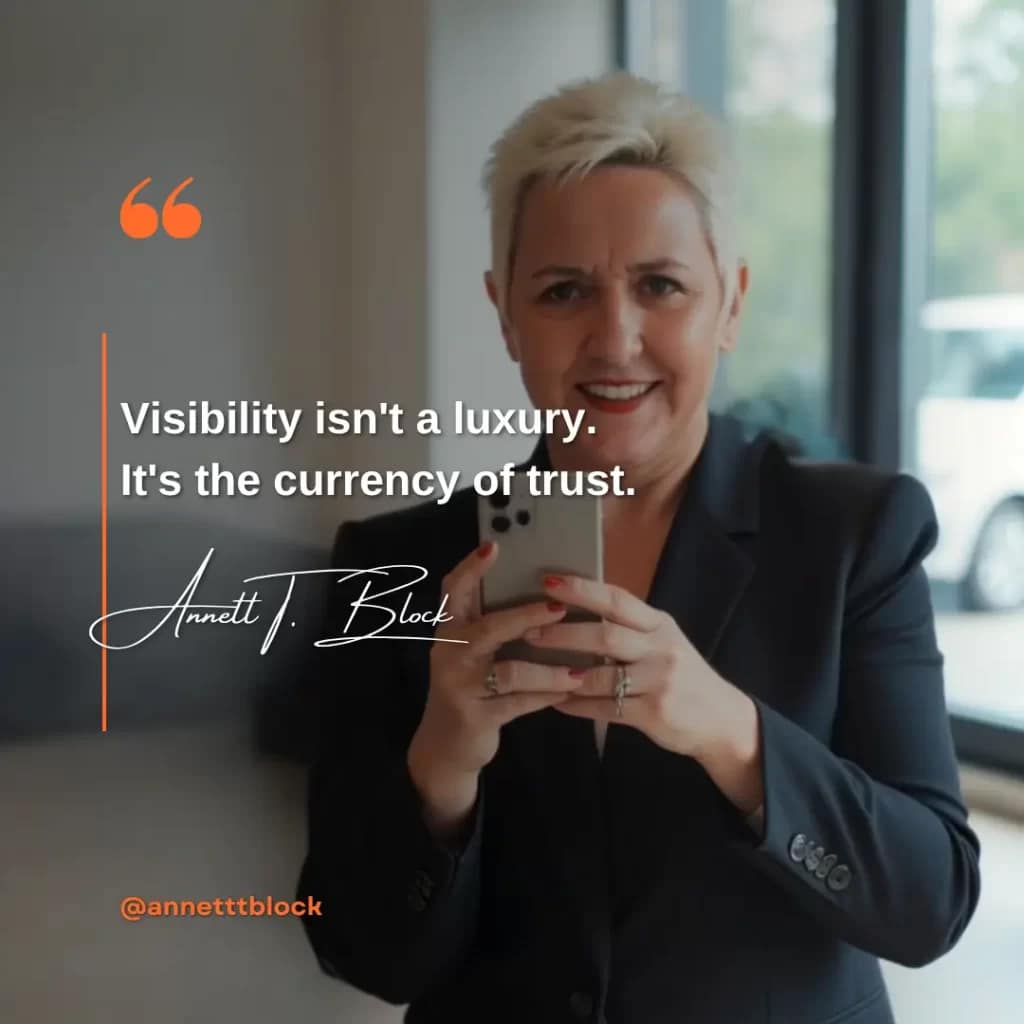
Most of the advice aimed at real estate agents who have fear of video treats the problem as a confidence issue. Get comfortable in front of the camera. Done is better than perfect. Your audience wants authenticity, not polish. That advice is not wrong exactly. It is aimed at the wrong diagnosis. The agents who have been in real estate for a decade and still have not posted a single video are not avoiding it because they lack confidence. They are avoiding it because they are making a specific calculation about professional risk and getting the math wrong.
The agent who has closed 300 transactions and built a referral network over fifteen years is not short on confidence. She negotiates contracts with difficult counterparts, manages client emotions through the most significant financial decisions of their lives, and regularly delivers news that clients do not want to hear. Confidence is not the gap. The gap is a specific calculation that sounds something like this: if I put my opinions on camera and distribute them to my entire market, something I say could alienate a potential client, embarrass me with a colleague, or be taken out of context in a way that damages the professional reputation I have spent years building. The risk is real. The agent who is making that calculation is not being irrational. She is being wrong about the comparative risk. The risk of appearing on camera versus the risk of remaining invisible while her market shifts around her.
Only 38 percent of real estate agents currently use video for their marketing, despite listings with video receiving 403 percent more inquiries than those without (REsimpli). That gap between effectiveness and adoption is not explained by a lack of awareness. Every agent knows video works. The gap is explained by the calculation described above, and by a set of specific fears that have not been examined clearly enough to be addressed.
Key Takeaway
The fear of video for established real estate agents is not about performance anxiety. It is about professional identity protection. The agent who avoids video is protecting a reputation built on referrals and personal relationships, and she is worried that public content will introduce variables she cannot control. That concern is legitimate. The calculation that produces avoidance from it is not, because the alternative to appearing on video is not a neutral outcome. Invisible is not safe. Invisible is losing ground to the agents in your market who are building recognition with the prospects you have not yet met.
Table of Contents
What the Fear Actually Is
When real estate agents who avoid video are asked directly about it, the answers cluster around a few specific concerns that are worth examining one at a time because each one contains a partially accurate premise and a significantly inaccurate conclusion.
The first concern is judgment from colleagues and peers. The agent who posts a market update video is suddenly visible to every other agent in their market, to their broker, to agents they have competed against for listings, and to people they knew early in their career when they were less experienced. The fear is that something they say will be recognized as wrong, naive, or poorly reasoned by someone whose professional opinion of them matters. This fear is based on a real dynamic. Colleagues do watch each other’s content. They do form opinions about it. What the fear misses is that the alternative (staying invisible) does not protect the agent from those opinions. It simply means those opinions are formed from absence rather than presence. An agent who does not appear on video is not being evaluated neutrally by colleagues and prospects. They are being evaluated as someone who does not do video, and in 2026 that evaluation has a specific meaning.
The second concern is being locked into a position. An agent who states a market perspective on camera has created a record. If the market moves differently than they predicted, that record exists. A client who disagrees with the agent’s stated position can reference the video in a dispute. A colleague who wants to undermine the agent’s credibility can share an old video in a new context. This concern is real and it is also based on a misunderstanding of what video content is. The agent is not being asked to make predictions they will be held to legally or professionally. They are being asked to share their current reading of a market they know well. Every agent shares market perspectives in conversation daily. The fact that those conversations are unrecorded does not make them more accurate or less accountable. It just makes them invisible.
The third concern is the one that goes least often articulated because it touches the deepest professional identity issue. The agent who has built their practice on personal relationships, referrals, and a carefully maintained professional reputation is afraid of what happens when their personality, voice, appearance, and manner of speaking are broadcast to an audience they cannot curate. The referral network they have built knows them in a specific context. The prospect who sees a video for the first time will form an impression without any of that relational context. The accent, the mannerisms, the specific way the agent phrases things. All of it is exposed to a judgment that the referral network never had to make because the relationship preceded the impression.
This is the fear I know most directly. When I started doing video in real estate, people told me the accent would work against me. That it would narrow my audience. That clients in certain markets would not work with an agent who sounded the way I did. That concern was not imaginary, people do make judgments based on accent and appearance. What the concern missed was the other side of that calculation. The clients who heard the accent and stayed anyway were not settling for a lesser option. They were self-selecting as exactly the clients who valued what I actually brought to the market. The accent did not narrow my audience. It filtered it toward the people I could serve best and away from the people who were never going to be a fit regardless of how polished the presentation.
Why the Risk Calculation Is Wrong
The agent who avoids video to protect her professional reputation is treating visibility as the risky choice and invisibility as the safe one. That framing has the risk located in the wrong place.
73 percent of homeowners say they are more likely to list with a real estate agent who offers video marketing (REsimpli). The homeowner who is considering listing their property is encountering agents through digital channels before they make a single phone call. They are watching videos, reading profiles, observing how agents talk about the market. The agent who is not present in those digital encounters is not being evaluated neutrally. They are not being evaluated at all. The prospects who would have been a natural fit for that agent’s specific expertise are forming relationships with other agents who were present when the decision was being considered.
The risk of visibility is that some prospects will form a negative impression. That is real. The risk of invisibility is that the prospects who would have formed a positive impression never encounter the agent at all and form relationships with competitors instead. Those two risks are not equivalent. The negative impression from visibility can be overcome in subsequent interactions. The absence of any impression from invisibility cannot be overcome because there is no subsequent interaction to have.
In 2025, buyers are skeptical of over-processed photos. Video offers transparency. Listings with video receive 403 percent more inquiries than those without, and it is not just about showing the kitchen but about proving you are a modern, tech-savvy agent capable of marketing your clients’ biggest asset (Getkoro). The seller who is evaluating agents is not just evaluating the agent’s local market knowledge. They are evaluating the agent’s ability to market a property effectively in the current environment. An agent who does not use video is signaling, whether they intend to or not, that they are not fully operating in the current marketing environment. That signal has a cost that the agent who avoids video is not counting in their risk calculation.
The correct calculation is not “what is the risk of appearing on video” versus “what is the risk of a specific video going wrong.” It is “what is the cumulative cost of being invisible to the portion of my market that is forming preferences through digital content” versus “what is the manageable cost of occasionally saying something imperfect on camera.” Stated that way, the calculation produces a different answer.
What Changes When the Fear Is Correctly Diagnosed
The agent who understands that her fear is about professional identity protection rather than performance anxiety approaches video differently than the agent who is trying to overcome stage fright. She is not asking how to get comfortable on camera. She is asking how to appear on camera in a way that reflects her actual professional expertise rather than exposing her to risks she cannot manage.
That is a solvable problem and it has a specific answer. The content that protects the agent’s professional identity most effectively while building the recognition the system requires is specific, locally grounded market perspective. Not opinion pieces that invite disagreement. Not predictions that can be proven wrong. Not personal content that introduces variables the agent cannot control. An agent talking about what is happening with inventory in a specific zip code right now, what the days-on-market trend in that area means for a seller who is considering timing, and what a specific recent transaction revealed about buyer behavior. That is the content that demonstrates the expertise the agent has spent fifteen years building. It is not vulnerable content. It is authoritative content.
The agents who continue to avoid video after understanding this distinction are usually protecting themselves from a risk that the content they would actually produce does not carry. They are imagining the worst version of what could happen if they appeared on camera and concluding that the risk is too high. The worst version is not what the Video for Real Estate system produces. The system produces specific, locally authoritative content from an experienced agent who knows more about their defined market than anyone watching the video. That content does not expose the agent to the risks they are afraid of. It demonstrates exactly the expertise that would have protected them from those risks if it had been visible all along.
What the First Video Actually Requires
The first video does not require confidence the agent does not yet have. It requires a clear answer to one question: what is one specific thing happening in my defined market right now that a buyer or seller in that area would benefit from knowing?
That question has an answer for every established agent. They have been observing and analyzing their local market for years. The information they carry in their head from active transactions, recent showings, conversations with other agents, and pattern recognition from years of experience is exactly the content that produces recognition when it is delivered on camera to a defined local audience.
The format does not need to be polished. Property videos that include the agent convert better than those that do not, and a few well-lit clips of an agent talking to camera about the local market can go a long way without requiring a script or studio setup. A phone propped against a water bottle on a desk, a window providing natural light, and the agent delivering two minutes of specific local market perspective is more effective for recognition-building than a production-level video delivering generic real estate advice.
The specific content matters more than the production quality. An agent who says “here is what I am seeing in the Parkland market right now and what it means if you are thinking about selling in the next six months” is delivering something the viewer cannot get from Zillow, from a national market report, or from any other agent who is not actively working that specific market. That specificity is the recognition-building mechanism. It is what makes the viewer form the association that eventually produces an inbound call from someone who says they have been watching the videos and have a question.
The first video does not need to be that refined. It needs to be specific enough that the viewer knows what market the agent serves and what perspective the agent brings to it. Everything after that is iteration. The agents who describe themselves as comfortable on camera almost all describe the same experience: the first video was uncomfortable, the tenth was less uncomfortable, and somewhere around the thirtieth the discomfort was no longer the thing they were thinking about. They were thinking about what they wanted to say.
What Invisibility Is Actually Costing
The agent who has been planning to start video for two years while running a productive referral-based business has not experienced the cost of that avoidance directly because referral pipelines are lagging indicators. The relationships that are producing referrals today were built over years of personal interaction. The pipeline looks healthy. The cost of not building a video presence is not yet visible in the current referral volume.
The cost shows up when the market shifts, when a referral source moves away or slows down, when a younger agent with a video presence starts appearing in the searches of people who would have called the established agent if they had known the established agent existed. By the time that cost is visible in the pipeline numbers, the agents who started two years earlier have a significant recognition advantage that takes time to close.
Homes listed with video sell up to 31 percent faster than those without, and 73 percent of homeowners say they are more likely to list with a real estate agent who offers video marketing (REsimpli). The established agent who avoids video is making a present-tense decision based on a present-tense pipeline that does not yet reflect the future-tense cost. The calculation looks fine today. It will look different in eighteen months when the agents who started two years ago have built the recognition infrastructure that produces preference before the first call.
The Pipeline Builder framework is built specifically for the agent who understands that the time to build the recognition layer is before the referral pipeline starts to show the cost of its absence. Not after. The agents who build it before they need it are the ones who never experience the pipeline pressure that forces a reactive response. The agents who wait until the pressure is visible are building from a weaker position with less time available.
Frequently Asked Questions About Video for Real Estate Agents
Does video content actually build pipeline for established agents or just for new agents building from scratch?
It builds pipeline at different stages for different reasons. New agents use video to establish credibility they have not yet built through transaction history. Established agents use video to make the credibility they have already built visible to the portion of the market that will never encounter them through a referral. The established agent’s video content converts better than the new agent’s because the depth of experience behind it is real and a viewer can tell the difference. The recognition it builds is more durable because the expertise it demonstrates is genuine.
What if something I say on video turns out to be wrong?
The content that builds the most durable recognition is not predictive. It is observational. An agent describing what is currently happening in their defined market, what recent transactions suggest about buyer and seller behavior, and what the current data means for someone considering a real estate decision is not making predictions. They are sharing current observations from an active practitioner. Those observations can be updated in the next video. The agent who says “three months ago I was seeing X and now I am seeing Y” is demonstrating exactly the kind of market attentiveness that makes a prospect want to work with them.
How long should real estate agent videos be?
For recognition-building distribution on social platforms, 60 to 90 seconds is the target for short-form content. For more substantive market analysis delivered through longer formats, two to four minutes allows enough development to demonstrate genuine depth. The length should be determined by how long the specific content requires to be delivered fully, not by a target number. A 45-second video that delivers one specific, useful observation is more effective than a three-minute video padded to feel substantial.
Do I need professional equipment to start?
No. A phone with a good camera, a window for natural light, and a clip-on microphone for audio quality covers the minimum requirements. Production quality becomes more relevant over time as the content library grows and the agent’s presence on the platform increases. The first several months of videos will be watched primarily by the warm audience being built through paid distribution, not by a cold audience evaluating production quality as a proxy for professionalism. The content specificity matters far more than the production level at that stage.
What if I have an accent or do not look the way I think I should look on camera?
The agents who describe their accent or appearance as a liability in their video content are almost always describing a filter, not a barrier. The prospects who respond negatively to a specific accent or appearance were not going to be an ideal client fit in any case. The prospects who respond positively to the content regardless of accent or appearance are exactly the clients who are selecting for the agent’s market expertise rather than surface characteristics. The filtering function of authentic video content is a feature, not a problem. The referral network an established agent builds over fifteen years does not select clients who work with the agent based on their accent. It selects clients based on trust and results. Video builds the same kind of trust at scale.
Final Thought
The agents who are building video presence right now are not more confident than the agents who are waiting. They are operating from a different calculation about where the real risk is. The risk they have decided to accept is that some percentage of viewers will form a negative impression. The risk they have decided to avoid is being invisible to the prospects who would have formed a positive one. That trade looks different every year as the portion of the market forming preferences through digital content increases. It looked different three years ago than it looks today. It will look different again in three years. The agents who made the trade early are compounding. The agents who are still calculating are not.
Start Your Pipeline Protection Review
Reference Resources
55 Real Estate Video Statistics 2025: adoption rates, inquiry lift data, and seller preferences for video marketing
Real Estate Video Marketing Strategy 2025: trust gap data and platform performance benchmarks for agent video content
Related Posts



*Results depend on market conditions, budget, and execution; this content is not legal or financial advice. Always align your targeting and messaging with Fair Housing rules, platform ad policies, and privacy regulations for lead handling.
Author Annett T. Block
Annett T. Block is a real estate marketing strategist and licensed Florida broker. She works with real estate agents who want to stop chasing leads that die on the vine and start attracting business from people who already know them through video-first warm audience building, retargeting, and consistent market presence. She is the founder of The Digital Adopters.
Her thesis is simple: The lead isn’t dead. You asked for the conversation before they knew you.
One agent. One market. ZERO COMPETITION.
In real estate since 2008. Licensed Florida Broker since 2011. More than 2,000 agents, teams, and brokerages served. Featured in Inman News. She is the author of From Listings to Legends.