

Most real estate ads are noise: “Just listed.” “DM me.” “Buy now.” “Dream home waiting.” That’s not marketing. That’s a billboard yelling at strangers. And the reason it feels spammy isn’t Facebook. It isn’t your offer. It’s your timing.
You’re trying to sell before you’ve earned the right to be heard.
If this feels familiar, it’s usually a timing problem… not a platform problem.
The 1 immediate fix
Stop running hard CTAs to cold audiences.
Replace:
- “Book a call”
- “Schedule a showing”
- “Click to get listings”
With an invitation CTA that starts a conversation:
- “DM “MAP” and I’ll send the short list of streets to watch.”
- “Comment “PLAN” and I’ll share the pricing framework buyers respond to.”
- “DM “COMPS” and I’ll tell you what the data actually says.”
This does two things instantly:
- filters for intent (you stop collecting ghosts)
- opens a relationship (you stop feeling transactional)
Real Estate Ad Retargeting
Why Cold Leads Don’t Convert (What Most Agents Get Wrong)
The reason most real estate ads flop isn’t because the offer is bad , it’s because the timing is wrong. Cold audiences don’t trust you yet. So when the first thing you do is ask for a form fill or an appointment, you trigger resistance.
What happens next is predictable:
- low engagement (Facebook stops showing you)
- higher costs (you’re paying to interrupt people)
- lower conversion (because nobody asked for you)
Ads work. Just not when they’re built like a cold pitch.
The Trust Equation (Why Warm Viewers Are Worth More)
Alternatively let’s talk leverage. Warm audiences are built from behavior, not hope.
If someone watches 25%+ of a video, that’s not a “view.” That’s attention with intent. It’s trackable, retargetable, and far more reliable than a random click.
Trust Equation:
Trust = Value × Consistency × Relevance
- Value: did you help or did you pitch?
- Consistency: do they see you more than once?
- Relevance: are you speaking to their problem in their market?
When those are present, your ads stop feeling like ads. They feel like competence.
The Sequencing That Makes Ads Stop Feeling Spammy
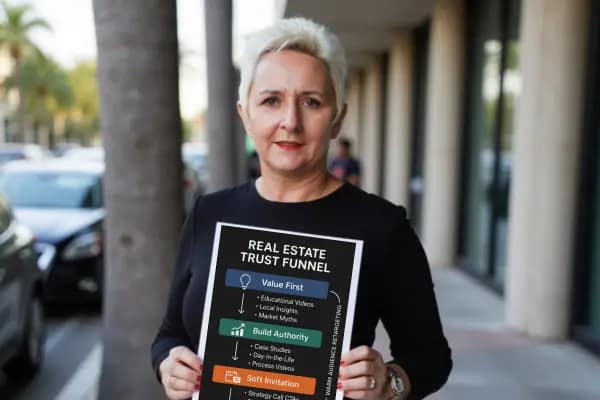
Spammy ads skip stages. High-trust ads follow a sequence:
1) Awareness (value-first)
Give a useful insight that earns attention.
- “3 things buyers overlook in [City]”
- “The pricing mistake that causes stale listings”
- “What to know before you waive contingencies”
2) Authority (how you think)
Show judgment and process.
- offer review framework
- pricing logic
- negotiation leverage
3) Invitation (conversation CTA)
Now the next step makes sense.
- DM keyword
- comment-to-receive
- “Want the checklist?”
This is the moment you stop being an interruption and become the safer option. Sequencing is what turns value into action without feeling pushy.
How to Build High-Trust Real Estate Ads (Warm Viewer Retargeting)
This is the clean system:
- Run awareness video to create warm viewers
- Build a custom audience from 25%+ viewers
- Retarget them with authority + proof
- Use invitation CTAs to start conversations
- Keep the loop alive with new value content
If you’re doing this right, your pipeline feels calmer because you’re not chasing people who never wanted you.
Final Thought
Spammy ads aren’t “too frequent.” They’re too early. If you want ads that convert without begging:
- earn attention
- build trust
- invite the conversation
- then convert
Trust isn’t a tactic. It’s the strategy.
*Results depend on market conditions, budget, and execution; this content is not legal or financial advice. Always align your targeting and messaging with Fair Housing rules, platform ad policies, and privacy regulations for lead handling.
About the Author
Annett T. Block is a U.S. Business Broker and Real Estate Marketing Strategist specializing in video-first authority, paid distribution, retargeting architecture. AI-supported visibility workflows for established real estate professionals and E-2 entrepreneurs.
Experience: 29+ years of U.S. Market Tenure | Licensed Florida Broker since 2011.
Outcome: recognition → trust → qualified inbound conversations.
Framework: Florida Connects Inc (E2 Acquisitions) & The Digital Adopters (Authority infrastructure)
Proof points: 2000+ agents/teams/brokers served (2020–2026) through training, implementation workshops, and/or paid distribution engagements.
Featured in: Inman News
Author: From Listings To Legends (Mastering the transition from visibility to authority).
Case Studies:Real estate ad and authority system results.
Author profile: About Annett T. Block
LinkedIn: LinkedIn profile
