

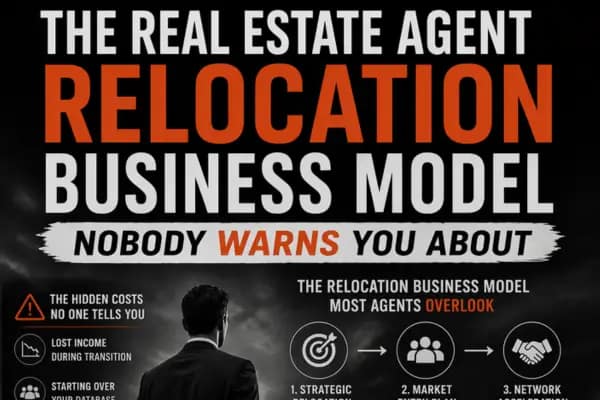
Every real estate agent relocation business model has a flaw nobody talks about before the move. You are not worried about whether you can sell real estate in a new city. You know you can sell real estate. What you are actually worried about, if you are being honest about it, is whether anyone in that new market will know it. That gap between what you are capable of and what the new market knows about you is not a confidence problem. It is a structural one.
Most relocating agents plan carefully for the logistics. They research licensing reciprocity, interview brokerages, study inventory and price points in the new market, and line up a brokerage before they arrive. That preparation is real and it matters. None of it is the problem.
The problem is what they do not plan for: the thing they built in their old market that will not make the trip with them.
Not their skills. Those transfer. Not their track record. That is portable too, in the sense that it happened and cannot be taken away. What does not transfer is the operating condition that made the business run. The accumulated local visibility, the embedded community trust, the referral relationships that took years to become automatic. It felt like reputation. It functioned like infrastructure. And infrastructure is not something you pack.
Most agents discover this six months into the new market, when the production numbers make it undeniable. This post is for the agent who wants to understand it before she goes, while there is still time to build something different.
Key Takeaway
Your old business model was not just a strategy. It was a proximity system. And proximity systems do not travel.
Table of Contents
What actually made your last market work
If you have been in real estate for more than three years, your business probably did not feel like it had a model. It felt like momentum. Clients called. Referrals came in. Past clients sent their friends. Deals came from people you ran into at school pickup or the coffee shop you went to every Tuesday.
That is not luck and it is not just likability. It is proximity compounding over time.
Every market appearance you made, every listing sign, every open house, every community event, every local video, every conversation at a neighborhood business, added a layer to a visibility stack that was entirely local and entirely dependent on your physical presence in that community. The referrals that felt organic were the output of years of proximity-based trust accumulation. The phone calls that seemed to come out of nowhere came from people who had seen your name enough times that when the moment arrived, you were the obvious choice.
That mechanism works. It is a legitimate and proven way to build a real estate business. But it is also the core weakness in every real estate agent relocation business model built on proximity alone. The only thing wrong with it is that it is completely tied to geography.
When the geography changes, the mechanism stops. Your production history does not tell the new market anything about you. Your track record exists in a city where you no longer live. Your referral network is populated by people who are no longer your neighbors and who will increasingly refer to whoever is physically present and visible. You are not starting from scratch in terms of skill or knowledge. You are starting from scratch in terms of the operating condition your business relied on.
That is a different problem than the industry typically acknowledges. And it requires a different solution.
Why the standard advice makes this worse, not better
The standard advice for relocating agents falls into three categories. All three are understandable. None of them fix a broken real estate agent relocation business model.
Join a team. This is the most common recommendation and on the surface it makes sense. A team gives you leads, infrastructure, and a brokerage identity in a market where no one knows your name yet. What it does not give you is a business you own. You are borrowing someone else’s infrastructure, which means your income is dependent on systems you do not control: the team leader’s lead quality, the brokerage’s pipeline, the promised CRM rollout that may or may not happen on schedule. The recognition gap in the new market stays open because the leads are not coming to you. They are coming to the team and you are one of several people working them. You can survive on a team. You cannot build transferable market authority through one.
Buy leads. Purchased contacts are not a pipeline. They are strangers with no reason to trust you, in a market where no one has seen your name before. Cold lead conversion is difficult enough in a market where you have name recognition. In a market where you are unknown, it is the most expensive and lowest-converting activity available. When a client finds you through a third-party portal or a purchased list, you are not the expert they sought out. You are, as the Zillow Alternative framework puts it, classified as a fulfillment vendor rather than the authority who architects the deal. No real estate agent relocation business model survives long when income depends on platforms that own the relationship with the client.
Hustle harder. Hustle is not a business model. It is what you do when you do not have one. More activity inside a proximity-dependent model, in a market where you have zero proximity, produces more effort and not more results. The agents who treat the post-move production dip as a motivation problem and respond by working longer hours are solving for the wrong variable. The constraint is not their work ethic. It is the model.
None of this means teams, leads, or effort are wrong. It means they are not solutions to a structural problem. Borrowing infrastructure, buying contacts, and adding hours to a real estate agent relocation business model that requires proximity you do not yet have all delay the confrontation with the real issue rather than resolving it.
The distinction that changes the rebuild
There are two categories of business-building activity in real estate and most agents have never needed to tell them apart because they have only ever operated in one market. Understanding this distinction is what separates a real estate agent relocation business model that compounds from one that collapses.
The first category is proximity-dependent activity. Open houses, local networking events, door knocking, floor time, community involvement, geographic farming. These work. They produce real results, but only after proximity is established, and establishing proximity takes time. In a new market, these activities are the right long-term investment and the wrong short-term strategy. You cannot accelerate trust accumulation by showing up more aggressively in a place where no one knows you yet. You can only wait it out.
The second category is transferable visibility activity. These are activities that build documented market presence not tied to geography: content that demonstrates expertise, video that builds familiarity before a conversation happens, a digital presence that tells the new market who you are and why that matters before you have knocked on a single door. These compound across the move rather than expiring with the zip code. They give you something the new market can find, watch, and form an opinion about before you arrive. And critically, they keep your old market active while you build the new one so you are not forced to choose between protecting what you built and starting what comes next.
A real estate agent relocation business model built on transferable visibility activities does not reset to zero when the zip code changes. That is the structural difference. Understanding how that pipeline is built, and why most agents build the wrong kind, is what The Pipeline Builder exists to document.
What to build before you leave
The agents who close the recognition gap quickly share one pattern: they did not wait until they landed to start. A solid real estate agent relocation business model is not assembled after the move. It is assembled before it.
Protect the old market first. Your existing sphere is an asset that will keep producing referral income if you maintain it deliberately. Most agents let it go quiet the moment the move becomes real: attention shifts forward, communication drops, and the relationships that took years to build start cooling within months. That does not have to happen. Your old market does not need to be abandoned the moment you leave. It needs a maintenance structure that keeps you present and referred while your attention is also on the new market. The real estate marketing resources library covers this in the context of staying remembered after transactions close. The same principle applies across a geographic move.
Start appearing in the new market before you arrive. Not cold outreach. Not paid ads. Documented presence that gives future clients a reason to recognize your name before you have had a single local conversation. When someone in your new market comes across your content, sees your name appear, or watches a short video where you demonstrate market knowledge, that moment of prior recognition is worth more than a dozen cold introductions made in person on day one. You cannot manufacture years of local trust, but you can manufacture months of documented familiarity. That window is available before you pack a single box.
Build infrastructure you own. The real estate agent relocation business model that survives a market reset is not built on borrowed systems. Not a team’s lead pipeline. Not a brokerage’s promised CRM rollout. Something that runs on your activity and produces visibility you control, where the asset accumulates to you and not to the platform, the team leader, or the brokerage. When that infrastructure exists, your income is not contingent on someone else’s systems staying functional. That distinction matters more in a vulnerable season than in any other.
None of this requires a large budget or a cleared calendar. It requires starting before the move compresses every decision into a crisis response.
The agents who rebuild fastest do one thing differently
The recognition gap is not fixed by arrival. It is fixed by lead time.
Every week that passes in the new market without your name appearing is a week of compounding unfamiliarity. The new market is not waiting for you. It is forming relationships with agents who are already visible, already referred, already trusted by the people in your future pipeline. A real estate agent relocation business model that accounts for this builds visibility before it is needed, not after it is missed.
Closing that gap from behind is possible. Agents more than a year into a move have done it. But it is harder and slower than closing it before it fully opens. The agents who come out of a relocation without a 12 to 18 month production trough are not more talented or more motivated than the ones who struggle. They started differently. They built visibility before they needed conversions. They protected the old market while starting the new one. They did not treat the move as the starting line.
If the move is still ahead of you, the starting line is now. Not when you land. Not when the new brokerage is sorted. Not when life settles. The mechanism does not wait for your schedule to clear. The gap compounds whether you are watching it or not.
Frequently Asked Questions The Real Estate Agent Relocation Business Model Nobody Warns You About
I haven’t moved yet. Is it too early to think about this?
No. It is the right time. The agents who rebuild fastest are the ones who were already building visibility in the new market before they arrived. Waiting until you land means starting from zero on day one in a place where no one knows your name. Starting now means day one in the new market is not an introduction, it is a follow-up.
I’m planning to join a team when I get there. Why isn’t that enough?
A team can keep income moving during the transition. That is a real benefit and in some situations it is the right short-term decision. The problem is that working a team’s leads in a new market does not build your recognition. It builds the team’s. When you eventually want to operate independently, you will still be starting from scratch on your own visibility. If the team is the whole plan, not a bridge to something you own, the structural problem is still unsolved.
My old market was referral-based. Can’t I just rebuild the same way in the new market?
You can, and eventually you will have to. The referral model works, it just takes time, and time requires income to keep arriving while you wait. The question is what produces income and visibility during the 12 to 18 months before the new referral base is established. Proximity-dependent relationship building is the right long-term answer. It is not a fast enough short-term answer to sustain a business through a market reset. You need both running at the same time, not sequentially.
What if I don’t have time to set this up before the move?
Then start with the smallest version of it. One activity, one market, one week. The guide linked below is built for this exact situation, it gives you a starting sequence designed to produce documented audience movement before the first 14 days are over, without requiring a cleared calendar or a large budget. The agents who say they do not have time to build visibility before the move are the same agents who spend 18 months rebuilding from zero after it. The time cost is lower before than after. It just does not feel that way until you are in it.
Final Thought on the Real Estate Agent Relocation Business Model
The move is going to happen. The question is what condition your business is in when it does.
The agents who come through a relocation without losing years of production momentum did not get lucky and they did not outwork the transition. They understood, before they left, that their old model was not coming with them and they built something different in time to matter.
You do not need a motivation speech. You need a mechanism. A documented starting sequence that keeps the old market producing while the new one is still learning your name. That is exactly what the free guide below was built to give you, written specifically for established agents who are relocating and cannot afford to start from zero.
Download the free guide for relocating real estate professionals here.
The market you are moving to does not know you yet. That is a solvable problem. The only question is whether you start solving it now or after the gap has already opened.
Reference Resources
National Association of Realtors 2025 Member Profile: supports the data on how much agent business comes from repeat clients and referrals versus cold sources.
HousingWire: Real Estate Agent Movement 2025: supports the finding that one third of agent moves in 2025 were distressed migrations driven by financial survival, not strategy.
HousingWire: How Real Estate Agents Are Reinventing Themselves: supports the argument that proximity-dependent models are under structural pressure and agents are being forced to rethink their business models.
Author Annett T. Block
Annett T. Block is a real estate marketing strategist and licensed Florida broker. She works with real estate agents who want to stop chasing leads that die on the vine and start attracting business from people who already know them through video-first warm audience building, retargeting, and consistent market presence. She is the founder of The Digital Adopters.
Her thesis is simple: The lead isn’t dead. You asked for the conversation before they knew you.
One agent. One market. ZERO COMPETITION.
In real estate since 2008. Licensed Florida Broker since 2011. More than 2,000 agents, teams, and brokerages served. Featured in Inman News. She is the author of From Listings to Legends.