

Most agents who struggle with pipeline inconsistency are not under-working their marketing. They are under-strategizing it.
The activity is there. The posting is consistent. The ads are running. The tools are in place. But the pipeline stays unpredictable because none of the activity is connected to a coherent real estate marketing strategy for real estate agents that gives each piece of content a specific job, a specific audience, and a specific role in moving a prospect from stranger to client.
Activity without strategy produces visibility without conversion. It creates awareness of a name the prospect cannot attach to anything specific. Each piece of content starts the familiarity process from scratch because there is no consistent positioning underneath it to accumulate. The prospect sees the agent repeatedly and still cannot answer the question that determines whether they call: why this agent, specifically, for my situation.
That gap between visibility and conversion is a strategy gap. Not a content gap, not a platform gap, not a budget gap. A real estate marketing strategy for real estate agents that closes that gap does not require more activity. It requires a different architecture underneath the activity you are already doing.
Key Takeaway
A real estate marketing strategy for real estate agents is not a content calendar or a platform plan. It is the positioning decision that gives every piece of content a specific job to do. Without that decision made clearly and specifically, marketing activity produces inconsistent pipeline regardless of how much effort goes into the execution.
Table of Contents
Why Most Real Estate Marketing Activity Does Not Produce Strategy
There is a specific pattern that shows up across agents who are doing the marketing work but not seeing it produce pipeline consistency.
They are present on multiple platforms. They are posting with reasonable frequency. They have tried paid ads. They have built some kind of follow-up system. And the results are inconsistent not because the execution is poor but because each piece of the marketing activity is operating independently of a coherent strategy that ties it together.
The posts on Instagram address a different audience than the ads on Facebook. The messaging on the website uses different language than the captions on social media. The content produced this week has a different focus than the content produced last week. Each individual piece is competent. None of them are reinforcing the same association in the prospect’s mind.
When marketing does not tell a consistent story it does not compound. Compounding requires repetition of the same specific message to the same specific audience over enough time that the prospect accumulates a clear association between the agent’s name and a defined expertise. That accumulation is what builds the trust that eventually produces inbound conversations.
Without compounding, each piece of content produces a linear result. A view, an impression, a like. And then it disappears. The next piece starts the process again from scratch. The prospect who has encountered the agent twenty times over six months has seen twenty disconnected pieces of content rather than one coherent argument repeated twenty times. They recognize the name. They do not know what the agent stands for. And that vague familiarity is not what drives the decision to call.
A real estate marketing strategy for real estate agents is the decision that turns disconnected activity into a compounding system. It determines who specifically the strategy is designed to reach, what specific positioning it is designed to build, and how every piece of content reinforces that positioning rather than diluting it.
One agent who worked through this process described the experience before the strategy was in place directly: “I’m tired of feeling invisible, even though I’m working all the time.”
That is the experience of activity without strategy. The effort is real. The visibility is real. The conversion is not happening because the visibility is not specific enough to produce the trust that closes the gap between being seen and being chosen.
The Three Components of a Real Estate Marketing Strategy for Real Estate Agents That Actually Produces Pipeline
A real estate marketing strategy for real estate agents that produces consistent pipeline is not complicated in structure. It has three components that work together. Most agents have pieces of each but have never assembled them into a coherent whole.
Positioning that is specific enough to be remembered.
Positioning is the decision about what your name means in the market. Not your bio. Not your value proposition. The specific association you want to exist in the mind of your ideal client when they hear your name or encounter your content.
Most agents have positioning that is too broad to be remembered. “Trusted, local, experienced” describes every agent in every market. It creates no specific association. The prospect who encounters it cannot distinguish the agent from the next agent they find, and when they cannot distinguish, they default to whoever they know personally or whoever responds fastest or cheapest.
Specific positioning sounds different. It describes a specific type of client, a specific type of transaction, a specific market insight, or a specific process in terms precise enough that a prospect who fits the description recognizes themselves immediately. When a prospect recognizes themselves in your positioning, the decision to reach out feels obvious rather than arbitrary. They are not choosing between you and other agents. They are identifying the agent who clearly understands their situation.
That recognition is what separates a real estate marketing strategy for real estate agents that produces inbound conversations from one that requires constant outbound effort to produce the same result.
Messaging that reflects the positioning consistently across every touchpoint.
Once the positioning is clear, every surface where the agent appears needs to reflect it. Bio. Website headline. Facebook and Instagram captions. Ad copy. Email subject lines. The language in every place a prospect might encounter the agent should be saying the same thing in different ways, not different things on different platforms.
The consistency of that messaging is what produces the compounding effect. A prospect who sees the same specific positioning on Instagram, then on Facebook, then on the agent’s website is not accumulating three separate impressions. They are accumulating one deepening association. Each exposure adds to the last. By the time they are ready to act, the association is strong enough to produce a decision without requiring additional convincing.
Most agents produce inconsistent messaging not because they are careless but because they have never made the explicit positioning decision that would make consistency easy. When the positioning is clear and specific, consistent messaging is the natural outcome. When the positioning is vague, every piece of content requires a fresh decision about what to say, and those fresh decisions produce inconsistent output.
A visibility engine that distributes the positioning to the right audience consistently.
The third component is the mechanism that delivers the positioning to the people most likely to become clients, repeatedly, over the long window between when they first become aware of the agent and when they are finally ready to act.
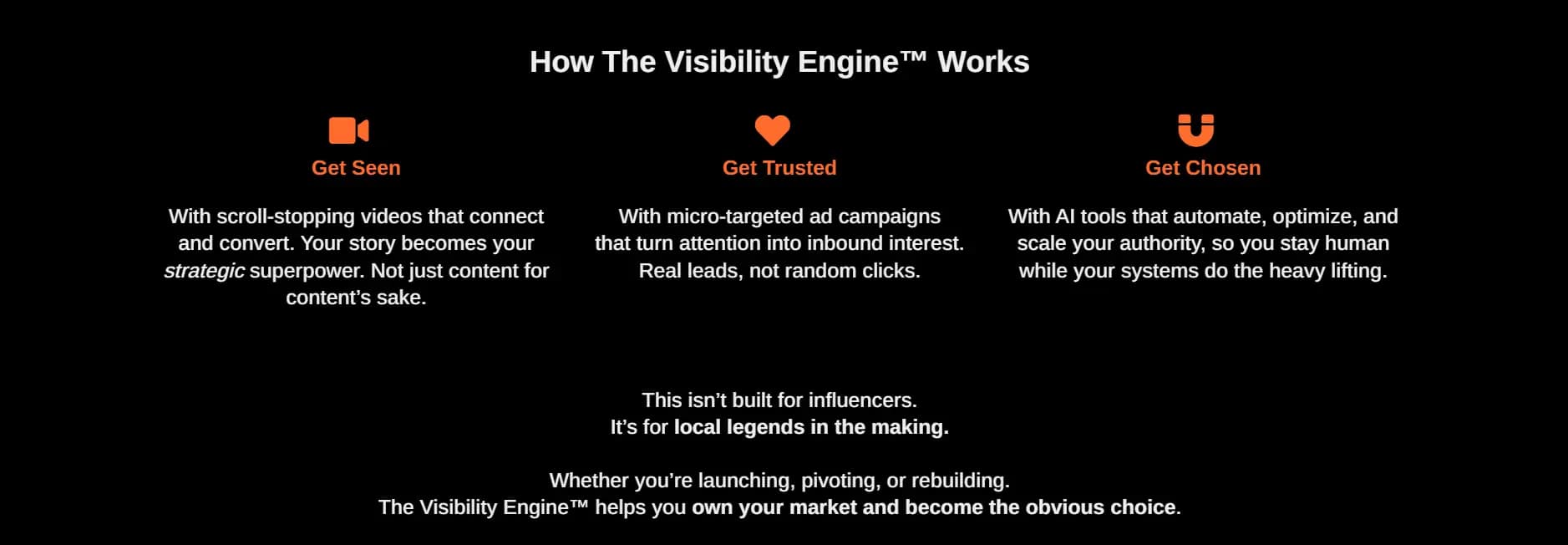
This is where the specific tools and platforms of a real estate marketing strategy for real estate agents come in. Paid distribution that extends the positioning beyond the existing network. Video content that builds the Recognition stage by demonstrating the expertise the positioning claims. Retargeting that deepens the relationship with warm audiences who have already engaged. Follow-up sequences that maintain contact with prospects across the 6 to 18 month window before they are ready to transact.
The visibility engine is not a content calendar. It is not a posting schedule. It is the infrastructure that ensures the positioning reaches the right people with enough frequency and consistency to produce the compounding familiarity that eventually becomes preference.
When all three components are in place, a real estate marketing strategy for real estate agents produces a specific result: prospects arrive at the first conversation already having decided, through weeks or months of consistent exposure, that this agent understands their situation. The trust-building that normally takes three or four appointments has already happened. The conversation starts from a foundation of familiarity rather than a cold introduction.
As one agent who implemented this approach described it: “Annett is one of the few people I trust in this space. Her depth of knowledge with messaging strategy is next-level. She’s who I go to when I want to understand what’s actually working.”
The outcome he was describing was not a better content strategy. It was a real estate marketing strategy for real estate agents built on positioning that made every piece of content work harder by giving it a specific job inside a coherent system.
The Positioning Decision Most Agents Avoid
The reason most experienced agents are operating without a real estate marketing strategy for real estate agents built on specific positioning is not ignorance. It is the discomfort of the positioning decision itself.
Committing to a specific positioning means saying clearly who you serve. It means accepting that being the obvious choice for a defined audience requires being less relevant to an undefined one. For agents who have built their businesses on broad relationships and stayed visible across every possible opportunity, that commitment feels like narrowing. Like risk. Like the possibility of losing the deals that fall outside the defined positioning.
The logic is understandable. It is also backwards.
A broad, undifferentiated position does not attract more clients. It attracts fewer, because the prospect who can substitute any agent for any other agent defaults to whoever they know, whoever comes cheapest, or whoever responds fastest. None of those defaults reward experience. None of them reward the depth of local knowledge that most established agents have spent years accumulating.
A specific position attracts fewer total prospects and more of exactly the right ones. The agent who is clearly positioned for a specific type of client in a specific market context does not compete with every other agent for every possible opportunity. They become the default choice for the clients who match their positioning, and those clients come to them already convinced rather than needing to be sold.
That is the shift a real estate marketing strategy for real estate agents built on specific positioning produces. Not more leads. Better ones. Not more activity. More of the right kind of conversations. Not more visibility. More of the right visibility with the right people at the right stage of their decision process.
The positioning decision is uncomfortable because it requires choosing. The pipeline inconsistency that results from avoiding that choice is far more expensive.
What a Real Estate Marketing Strategy for Real Estate Agents Looks Like When It Is Working
When the three components are in place and aligned, the experience of marketing changes.
The content gets simpler to produce because every piece of content has a clear job. It is not a fresh decision about what to say. It is the same specific positioning expressed through a new piece of evidence, a new client story, a new market observation, a new angle on the same argument. The agent who used to stare at a blank screen wondering what to post now has more material than they can publish because every experience in their business is potential content for the positioning they have committed to.
The conversations that result from the marketing start differently. The prospect who reaches out has been accumulating exposure to the specific positioning for weeks or months. They are not calling because they found the agent’s name in a search. They are calling because the agent’s positioning has answered the question that determines whether they call. They already know who this agent is, what this agent stands for, and why this agent is the right choice for their situation. The first conversation is not an introduction. It is a confirmation.
The referrals become more specific. Past clients who understood the positioning refer prospects who fit it. They do not just say “call my agent.” They say “call this agent because she specializes in exactly your situation.” That specificity is a referral trigger that pre-qualifies the prospect before the first contact. It is only possible when the positioning is clear enough that the past client can carry it.
The Pipeline Builder framework is built around exactly this dynamic. Visibility, Recognition, Pipeline, Conversation, Transaction, each stage supported by a real estate marketing strategy for real estate agents that moves the right prospects through the sequence with positioning doing the trust-building work at every step. Not the agent’s active effort at every step. The positioning. The strategy. The infrastructure that runs whether the agent is at a closing or not.
Frequently Asked Questions About Real Estate Marketing Strategy for Real Estate Agents
What is the difference between a real estate marketing strategy for real estate agents and a marketing plan?
A marketing plan describes what you will do, which platforms, which content types, which budget allocation, which posting frequency. A real estate marketing strategy for real estate agents describes why you are doing it and what it is designed to produce at the positioning level. Most agents have some version of a plan. Very few have the strategy underneath it that gives the plan a coherent direction. A plan without a strategy produces organized activity. A strategy without a plan produces good intentions with no execution. Both are necessary. The strategy comes first.
How specific does the positioning need to be for a real estate marketing strategy to work?
Specific enough that a prospect who matches the description recognizes themselves when they encounter it. Not so narrow that it excludes everyone except a handful of potential clients. The practical test is whether a prospect who fits the positioning would read the agent’s messaging and think “this is exactly what I need” rather than “this sounds like every other agent.” If the messaging could apply to any agent in any market, it is not specific enough to produce the compounding association that builds pipeline.
Can an experienced agent with a broad market change their positioning without losing existing clients?
Yes. Existing clients are not lost by clarifying positioning. They were attracted by the relationship and the service quality, not by the breadth of the positioning statement. Clarifying the positioning for future marketing does not retroactively change the relationship with past clients. It changes who the marketing attracts going forward. The transition is not abrupt. The positioning becomes more specific over time in the new content and messaging while existing relationships continue on the basis they were built.
What is the most important thing to get right in a real estate marketing strategy for real estate agents?
The positioning. Before any platform decision, any content investment, any ad spend, or any tool adoption, the question to answer is whether the positioning is specific enough to produce a clear association in the prospect’s mind. Everything else in the real estate marketing strategy for real estate agents is downstream of that answer. A specific positioning makes every subsequent decision easier and every subsequent piece of content more effective. A vague positioning makes every subsequent decision harder and every subsequent piece of content less effective regardless of how well it is executed.
Final Thoughts
If your marketing activity is producing visibility but not the pipeline consistency that should follow from it, the Pipeline Protection Review is a direct look at what the positioning gap is and what a real estate marketing strategy for real estate agents built on your specific market and audience would look like.
Start Your Pipeline Protection Review
Reference Resources
- NAR 2025 Member Profile: data on experienced agent pipeline patterns and the relationship between positioning and pipeline consistency
- NAR 2025 Profile of Home Buyers and Sellers: data on how buyers and sellers select agents and the role of trust and familiarity in that decision
- REsimpli Real Estate Marketing Statistics 2025: data on marketing performance benchmarks and conversion patterns for real estate agents
*Results depend on market conditions, budget, and execution; this content is not legal or financial advice. Always align your targeting and messaging with Fair Housing rules, platform ad policies, and privacy regulations for lead handling.
Author Annett T. Block
Annett T. Block is a real estate marketing strategist and licensed Florida broker. She works with real estate agents who want to stop chasing leads that die on the vine and start attracting business from people who already know them through video-first warm audience building, retargeting, and consistent market presence. She is the founder of The Digital Adopters.
Her thesis is simple: The lead isn’t dead. You asked for the conversation before they knew you.
One agent. One market. ZERO COMPETITION.
In real estate since 2008. Licensed Florida Broker since 2011. More than 2,000 agents, teams, and brokerages served. Featured in Inman News. She is the author of From Listings to Legends.