

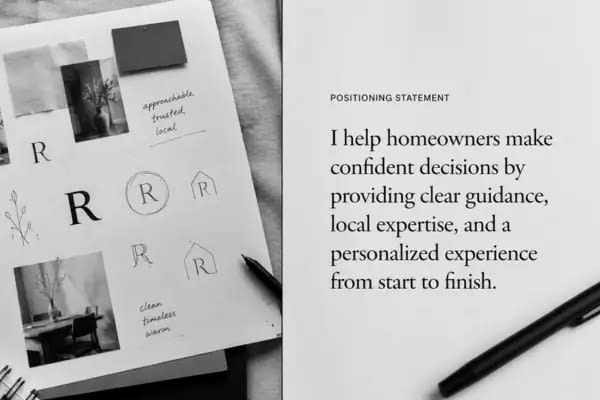
Positioning is the decision. Branding is that decision made visible. Confuse branding vs positioning for real estate agents and the order and you spend money on a look before you’ve decided what you stand for.
I sat down with an agent last year who had just spent close to four thousand dollars on a rebrand. New logo. New color palette. A photographer for a full day of headshots. She showed me the deck with real pride, and it was polished work.
Then I asked her one question. Who is this for, and why should they pick you over the next agent in the same zip code?
She could not answer it. Not because she wasn’t smart. Because nobody had asked her to decide that before the designer opened a laptop.
That is the mistake I see more than any other. Agents build the branding first and hope the positioning shows up later. It rarely does.
What is branding vs positioning for real estate agents?
Positioning is the decision: who you help, what problem you solve, why you’re different from the next option. It’s strategic and internal.
Branding is that decision made visible, your voice, your visuals, your messaging, the way you show up in content. It’s the packaging of positioning, not something you do before or after it.
Key Takeaways
- Positioning is the strategic decision about who you serve and why you’re different. Branding is how that decision looks and sounds to the outside world.
- You cannot skip positioning and go straight to branding. A logo without a decision behind it is just decoration.
- Most agents who “have branding” and still don’t get remembered are missing positioning, not a better color palette.
- The market is verifying agents online before ever calling. What they find has to say something specific, or it says nothing at all.
- Fixing this order, positioning first, branding second, is a one-time decision that every future piece of content gets to inherit.
Table of Contents
Why Do So Many Confuse Branding vs Positioning for Real Estate Agents?
Because branding is the part you can see, and positioning is the part you have to think through. A new logo feels like progress. A new headshot feels like progress. Deciding exactly who you serve and why you’re the right choice for them feels slower, less exciting, and honestly a little uncomfortable, because it means saying no to some business.
So agents skip the uncomfortable decision and go straight to the visible one. They end up with a brand that looks clean and says nothing. Consistent colors, no clear reason to choose them.
I have watched this happen inside my own brokerage. An agent comes in with a beautiful Instagram grid and can’t tell me, in one sentence, who that grid is for. The visuals are doing work with no direction behind them.
What Does the Data Say About How Buyers Actually Choose an Agent?
This is not a branding problem in theory. It shows up in the numbers.
According to Zillow’s 2025 Consumer Housing Trends Report for Agents, 33 percent of buyers say online research played a key role in how they chose their agent, and 36 percent of sellers now find their agent through online channels, more than double the 15 percent share in 2018. That is not a slow trend. That is a shift that happened inside less than a decade.
That means a third of buyers, and more than a third of sellers, are forming an opinion about you before any conversation happens. They land on a website or a profile with no context, and they decide in seconds whether this person is worth a call.
A branded look with no positioning behind it does not survive that moment. A generic “your local real estate expert” tagline does not survive that moment either. What survives is a clear, specific answer to the question every buyer is silently asking: why you, and not the next agent in the same search.
The National Association of Realtors’ 2025 Profile of Home Buyers and Sellers confirms agents still matter deeply once that first look happens: 88 percent of buyers and 91 percent of sellers ultimately worked with an agent or broker, both near record highs. The relationship still wins. But positioning decides who gets invited into it.
Branding Is Packaging, Not a Separate Stage
Here is where I want to correct how most people draw this out. The common version treats positioning and branding as two steps in a sequence, positioning first, then branding second, like two boxes on a timeline.
That is not quite right, and the difference matters.
Branding is not step two. Branding is the output of step one. It is not something you do after positioning is finished. It is what positioning looks like once it has a voice, a visual language, and a way of showing up in the world. You cannot separate them into a before and after, because branding without positioning behind it is not branding. It is decoration with no argument underneath it.
I call this Position First, Package Second. Not two stages on a calendar. One decision, followed by everything that makes the decision visible.
This is also why a rebrand alone rarely fixes a stuck business. If the agent hasn’t decided who they serve and why, a new logo just repackages the same confusion in nicer fonts.
How Do You Actually Fix This in Your Own Business?
Start with the decision, not the design.
Positioning gets decided by answering three questions honestly. Who exactly do you help? First-time buyers in a specific price range, luxury sellers, relocating families, investors, whoever it actually is. What problem do you solve for them that they cannot easily solve alone? And why would they pick you specifically, not just “a good agent,” but you?
Once those three answers exist in writing, in your own words, everything else has direction. Your logo has a job. Your Instagram grid has a job. Your listing descriptions, your video content, your headshots, all of it now has a decision behind it instead of guessing at what “professional” is supposed to look like.
This is the same principle behind visibility building. You cannot control who searches for you. You can control what they find. Positioning decides what that discovery should say. Branding is how it gets said.
Practical Steps to Get Your Positioning and Branding in the Right Order
- Write your positioning statement before you touch anything visual. One or two sentences. Who you serve, the problem you solve, why you specifically. Draft it, sit with it for a day, then sharpen it.
- Test it against a real listing or a real client story. Does the positioning statement actually describe how you handled that transaction? If it doesn’t hold up against something real, it’s still theory.
- Audit your current branding against that statement. Pull up your website, your social profiles, your last five posts. Does the visual language and the language you use match who you said you serve, or was it built for a generic “everyone” audience?
- Fix the biggest mismatch first. You don’t need to redo everything at once. Find the one place your branding contradicts your positioning most obviously, usually your homepage or your bio, and fix that first.
- Build new content from the positioning statement outward. Every post, every video, every listing description should be able to trace back to the answer you wrote in step one. If it can’t, ask why you’re making it.
- Revisit the statement every twelve months, not the visuals. Positioning should hold steady for a year or more. If you’re changing your positioning every few months, that’s the real instability, not your color palette.
Frequently Asked Questions on Branding vs Positioning for Real Estate Agents
Do I need to rebrand every time I refine my positioning?
No. Small positioning refinements usually just mean adjusting your messaging and content, not your logo or colors. A full rebrand only makes sense when your positioning has genuinely changed who you serve or how you’re different, not when you’re simply getting clearer on what you already decided.
Isn’t branding just as important as positioning?
They’re both necessary, but they’re not equal in sequence. Branding without positioning behind it has nothing to communicate. Positioning without branding never gets seen. You need both, but positioning has to come first or the branding has nothing true to express.
What if I don’t know who I want to serve yet?
Start with who you’ve already served well. Look at your last five to ten closed transactions and find the pattern, price range, property type, buyer situation. Your positioning often already exists in your past work. You just haven’t named it yet.
Can a logo or color palette actually hurt my business?
Not directly, but a polished look with no clear positioning behind it can make you forgettable in a market where buyers compare 4.3 websites before reaching out. Consistency without a decision behind it just makes the confusion look more expensive.
How is this different from just “finding my niche”?
A niche is often just a category, like luxury or first-time buyers. Positioning goes further. It’s the specific reason someone in that category should choose you over every other agent chasing the same niche.
Final Thoughts on Branding vs Positioning for Real Estate Agents
That agent I mentioned at the start eventually went back and did the work she’d skipped. Not another rebrand. A single afternoon writing down, in plain language, who she actually serves and why. The logo didn’t change. The photos didn’t change. But the words around them finally had something to say.
Branding is not the finish line. It’s not even a separate race. It’s what your decision looks like once it’s ready to be seen. Make the decision first. Let the branding tell the truth about it.
Keep Learning
- Why Lead Generation Without Authority Breaks Down: What happens when agents chase leads before buyers know who they are.
- The Real Estate Omnipresence Strategy: How consistent positioning across channels collapses comparison shopping before it starts.
- Real Estate Visibility vs. Pipeline Opportunity: Why being seen and having a working pipeline are not the same thing.
- Too Many Real Estate Marketing Options: How to choose where to focus when every platform says it’s the answer.
About the Author
Annett T. Block helps real estate agents stop chasing leads that die on the vine and start attracting business from people who already know them, through video-first visibility built in one market at a time. One agent. One market. Zero competition.
Last Updated: August 2026
Related Posts



Author Annett T. Block
Annett T. Block is a real estate marketing strategist and licensed Florida broker. She works with real estate agents who want to stop chasing leads that die on the vine and start attracting business from people who already know them through video-first warm audience building, retargeting, and consistent market presence. She is the founder of The Digital Adopters.
Her thesis is simple: The lead isn’t dead. You asked for the conversation before they knew you.
One agent. One market. ZERO COMPETITION.
In real estate since 2008. Licensed Florida Broker since 2011. More than 2,000 agents, teams, and brokerages served. Featured in Inman News. She is the author of From Listings to Legends.