

The gap between local reputation and online recognition is where your next listing is quietly leaking out.
An agent in one of the communities I work with recently asked me whether it was worth risking $10,000 on marketing. One portal lead had taken four years to turn into a closing. Four years of nurture for a single deal is not a marketing problem. It is a recognition problem, and it is more common than most agents realize.
Here is the direct answer. The portals showing your face beside a listing, the search directories ranking who shows up first, the buyer who Googles you before calling, the seller comparing three agents on a laptop before any of them know it is happening. None of that rewards how loud you are. It rewards how consistently you have left evidence of who you are, what you have done, and who has already worked with you, sitting there before the buyer ever needed to ask.
This is the real estate agent recognition gap: the distance between how well known you actually are locally and how little of that is documented anywhere a stranger would go looking. If you have not closed it deliberately, someone else’s evidence is filling it for you, whether that is a competing agent, a portal profile you never claimed, or nothing at all.
Key Takeaways
- Buyers and sellers are researching and comparing agents online before making first contact, and most decide fast once they do.
- “Everyone in town knows me” is a local reputation claim. It is not the same as a verifiable digital footprint, and buyers can only act on what they find.
- Commission scrutiny has made buyers and sellers ask a harder question than they used to: what, exactly, am I paying for. Recognition is how you answer that before they ask it out loud.
- The recognition gap is not fixed by louder content. It is closed by consistent, verifiable evidence of who you are, left in every place a consumer might look.
- The fix is not a bigger marketing budget. It is documentation, done consistently, over a longer runway than most agents give it.
Table of Contents
Why Does “Everyone in Town Knows Me” Stop Working?
I have rebuilt a local market presence from close to nothing before. When I came into real estate in 2008, I learned the business through foreclosures and short sales, in a market where nobody was handing out trust for free. You could not talk your way into credibility during a crash. You had to show it, deal by deal, until the evidence added up on its own.
Most agents I talk to today are not in a crash. They are in something quieter and, in some ways, harder to see: a market where they are genuinely well known locally and still cannot explain why the phone is not ringing the way it should. This is the same structural pattern I wrote about in why a slow pipeline is usually not the market’s fault: the business has been in the business for years, has closed real deals, has a sphere that would vouch for them, and none of that reputation exists anywhere a stranger, or even a semi-warm lead, would actually go looking.
That gap has stopped registering as a problem for most agents. It has become “just how the industry is.” Leads go cold. Referrals stall. A listing photo gets attention and the inquiry goes nowhere because the person behind the photo is, functionally, a stranger with no verifiable history attached. The instinct is to blame the lead source. The actual issue sits one level up, and it is the same one I laid out in the positioning problem most agents don’t name: the agent is recognized in the room, and undocumented everywhere else.
What Does the Data Say About How Buyers Choose an Agent?
The shift toward research-before-contact is not a hunch. According to Zillow’s 2025 Consumer Housing Trends Report for Agents, 36% of home sellers now find their agent through online channels, more than double the 15% share from 2018, and a third of buyers say online research played a meaningful role in how they chose theirs. That is not a niche behavior anymore. It is the default starting point for a growing share of your market.
What happens after that research is just as telling. The same Zillow report found that 47% of buyers hired the first agent they spoke with, and 59% of sellers did the same. The decision is often functionally made before the call, based on what the buyer or seller found beforehand, and the conversation itself just confirms it.
The Consumer Federation of America’s research on agent selection adds the piece that makes this urgent rather than merely interesting: close to 90% of buyers and sellers use an agent, but most of them run a limited search and contact only one. There is rarely a long shortlist to fight your way onto. There is often exactly one name that surfaced clearly enough to get the call, and everyone who did not surface clearly does not get considered at all. I broke down what that actually costs an agent over a year in the real cost of staying invisible, and it is higher than most agents assume.
Commission scrutiny sharpens this further.
The NAR settlement’s $418 million fund is in its distribution phase this year, a separate $120 million buyer settlement has a filing deadline of October 27, 2026, and state-level cases are still working their way through the courts. Buyers and sellers are more aware than ever that commissions are negotiable and that they are allowed to ask what they are actually paying for. An agent with no visible track record is asking someone to trust a number with nothing behind it. An agent with a documented one is answering the question before it gets asked. This is also the mechanism behind a pattern I covered in what’s actually driving a stalled pipeline: the leads were never the issue.
Portals compound this rather than solving it on their own. A profile you have not claimed or updated does not just fail to help you. It is a data point someone finds while comparing you to an agent who has, and I have watched that comparison lose deals for agents in how portals like Zillow use your own listing against you.
Why Does Recognition Have to Come Before Representation?
Most agents treat visibility and the sales conversation as the same move. They post a listing, or run an ad, and expect it to produce a client on the spot. That is the premature conversation: asking someone to choose you before they have any reason to recognize you.
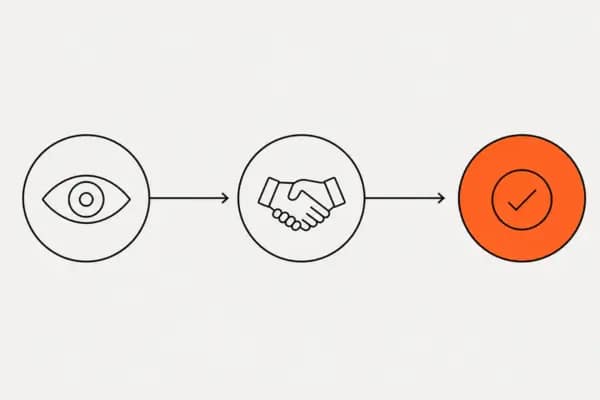
Representation, the moment someone actually signs with you, is not the first step. It is the last one in a sequence that has to happen in order: Be Seen. Be Trusted. Be Chosen. Recognition is not marketing flavor text sitting on top of your business. It is the precondition for representation. Skip it, and every lead you generate is starting the relationship from zero, no matter how good your follow-up script is.
This is the distinction most lead-gen advice misses entirely. It treats the symptom, lead volume, instead of the actual mechanism, whether a stranger encountering your name for the first time has any way to verify that you are who you say you are before they decide to trust you with the largest financial transaction of their life.
What Does Closing the Recognition Gap Actually Look Like?
I built an E-2 visa community I run the same way, without ever running an ad for it. Nine and a half thousand members joined over a decade because the same information, delivered consistently and honestly, showed up in the same place again and again until it became recognizable on its own. Nobody joined because I asked them to. They joined because the evidence was already there by the time they went looking.
The same mechanism works for a local market, and it starts with the fundamentals I laid out in becoming the most recognized agent in your market: treating your digital footprint as infrastructure, not decoration.
Start with what a stranger actually encounters. When someone searches your name, or the name of an agent in your market, what comes back has to be consistent: the same headshot, the same bio details, the same track record, showing up the same way on the portal, on your website, on your Google profile, on social. Consistency is what turns a scattered set of mentions into a recognizable identity, which is the whole premise behind building a personal brand agents can actually be found by. A profile that has not been touched in two years does the opposite of what a listing photo does. It attracts attention and then quietly damages the trust it just earned.
From there, the evidence has to be verifiable, not just present. A claimed transaction history. Reviews that came from real clients, not friends. Video where you are actually speaking, not a stock photo with your name under it. This is the difference between being findable and being credible, and it is why strategic visibility matters more than raw activity. Buyers are not looking for proof that you exist. They are looking for proof that you can be trusted with something they cannot afford to get wrong.
How Do You Close the Real Estate Agent Recognition Gap in Six Steps?
Audit what a stranger actually finds. Search your own name from an incognito browser. Check your Zillow, Realtor.com, Google Business Profile, and social accounts as if you had never heard of yourself. Note every place the information is outdated, inconsistent, or missing entirely.
Standardize the basics everywhere. Same headshot, same bio, same specialty language, same contact details, across every platform. This is the single highest-leverage fix most agents have never made, and it costs nothing but an afternoon.
Turn your closed deals into visible proof. Claim every transaction you can on the portals that allow it. A profile with a documented history reads as established. A blank one reads as new, even after twenty years in the business.
Build a review system, not a review request. Ask for a review at a specific, repeatable moment in every closing, not only when a deal went unusually well. This is the practical layer underneath what I wrote about in building real trust, not performed trust: a pattern of recent, real reviews is what buyers actually check for before they call.
Create content that documents expertise, not just listings. Market updates, walkthroughs of your process, honest answers to the questions buyers actually ask. This is what a stranger uses to decide you are the real thing before they ever pick up the phone. It is a different mechanism than paying for reach, which is the distinction I make in why buying leads doesn’t fix a recognition problem.
Give it longer than you want to. Most agents abandon this exact process around month two, right before it starts converting. Recognition compounds. It does not spike. Commit to a minimum runway of two full quarters before judging whether it worked.
Frequently Asked Questions About the Real Estate Agent Recognition Gap
Does being active on social media count as recognition?
Not by itself. Recognition requires consistency and verifiability across every place a buyer or seller might look, not just visibility on one platform. Active social media helps, but it is one input into a larger footprint, not a replacement for it.
How long does it take to close a recognition gap?
Most agents see early signals within two to three months, and real traction closer to six. This tracks with a known pattern: agents commonly quit visibility-building around month two, right before it would have started working. Treat the runway as a minimum, not a suggestion.
Isn’t this just SEO for real estate agents?
It overlaps with SEO but is broader. SEO gets you found in a search. Recognition is what happens after you are found: whether what a buyer sees actually builds trust before they call. You can rank and still fail to convert if the profile behind the ranking reads as generic or unverified.
What if I already have a lot of local referrals?
Referrals prove your reputation is real. They do not make it visible to anyone outside your existing sphere. The agents with the strongest local reputations often have the weakest digital footprints, because they have never needed one to survive until now.
Do I need to spend money on ads to fix this?
No. Most of what builds recognition, consistent profiles, claimed transaction history, a real review system, is free and requires time rather than budget. Paid visibility can amplify recognition once it exists. It cannot substitute for it.
Final Thought
That agent’s real question was never about $10,000. It was about whether marketing works, framed as a bet on one portal lead that took four years to close. The honest answer is that the marketing was not the problem. Four years is what it takes to build trust with someone who had almost no verifiable reason to trust you sooner, because there was nothing documented to shorten the distance.
You did not spend thirty years becoming a stranger. You spent them becoming known, one closing, one referral, one honest conversation at a time. The only thing missing is evidence of it, sitting where the next buyer or seller will actually look before they ever call.
You are not being replaced. You are being undocumented.
Keep Learning
- How to Become the Most Recognized Agent in Your Market: the fundamentals behind closing the gap this article names.
- The Real Cost of Staying Invisible as a Real Estate Agent, Per Year: what the recognition gap actually costs, priced out.
- Is Zillow Stealing Your Listings?: how portals use an unclaimed or thin profile against you.
- You Have a Real Estate Positioning Problem: the deeper pattern underneath the recognition gap.
About the Author
Annett T. Block is the founder of Turnkey Media Marketing, where she helps real estate agents build recognition before they ever ask for representation. She has worked in real estate since 2008, building her business through the foreclosure and short-sale market during the crash, and founded Florida Connects brokerage in 2011. She also built and has led a community of more than 9,500 members organically over a decade, without ever running an ad for it, and has worked with more than 2,000 real estate agents, teams, and brokers on visibility and business systems.
Last Updtaed: Septembr 2026
Related Posts



Author Annett T. Block
Annett T. Block is a real estate marketing strategist and licensed Florida broker. She works with real estate agents who want to stop chasing leads that die on the vine and start attracting business from people who already know them through video-first warm audience building, retargeting, and consistent market presence. She is the founder of The Digital Adopters.
Her thesis is simple: The lead isn’t dead. You asked for the conversation before they knew you.
One agent. One market. ZERO COMPETITION.
In real estate since 2008. Licensed Florida Broker since 2011. More than 2,000 agents, teams, and brokerages served. Featured in Inman News. She is the author of From Listings to Legends.