


Most agents blame the platform. The real problem is the strategy behind the ads.
Most real estate agents running lead generation ads for real estate are not failing because Facebook is broken.
They are failing because they are running the wrong type of ad at the wrong time to the wrong audience.
That distinction matters. A lot.
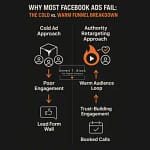
The agents buying leads from platforms like Zillow are paying for strangers who have not decided they trust anyone yet. The agents spending money on lead form ads from a cold audience are interrupting people who have never heard of them. Neither approach fails because the platform is bad. Both fail because trust was never built before the ask was made.
Lead generation ads for real estate work. The method most agents are taught does not.
This post breaks down what is actually happening when your ads do not convert, why the structure of most real estate ad campaigns sets agents up to lose money from day one, and what a trust-first ad strategy looks like when it is built to actually fill a pipeline.
Key Takeaways
- Lead generation ads for real estate fail most often because they ask for the conversion before trust exists.
- Cold lead forms produce low-quality leads because the prospect has no relationship with the agent running the ad.
- A retargeting-based ad structure produces warmer conversations at a fraction of the cost of direct lead generation.
- The $5-a-day content ad strategy builds a local audience of people who already know who you are before you ever ask for anything.
- Consistency in ad structure matters more than ad spend.
Table of Contents
Why Most Lead Generation Ads for Real Estate Agents Miss the Point
There is a moment most agents experience about sixty days into running Facebook lead ads.
They have spent $300 or $400. Maybe more. They have a list of names and phone numbers. They start calling. Nobody picks up. The ones who do are not sure why they filled out the form. Some say they were just curious. Others do not remember doing it at all.
The agent starts questioning the platform. The budget. The targeting.
The real problem is simpler than any of those.
They asked a stranger to hand over their information before that stranger had any reason to trust them.
This is where most real estate ad strategies break down. Not in the targeting. Not in the budget. In the sequence.
A lead generation ad placed in front of a cold audience is not a lead generation tool. It is a cold call with a logo.
The agents who built real pipelines through paid advertising did something different. They did not start with the ask. They started with value. They built familiarity first. Then they asked.
That shift in sequence changes everything.
I have watched agents run $5-a-day content ads for thirty days and end up with a warm local audience of 600 to 1,200 people who have watched their videos, seen their face, and heard them speak about the local market. Those people are not cold. They know who the agent is before the first conversation.
That is the difference between a lead and a relationship. And that difference is where real estate lead generation either converts or dies.
What the Research Actually Shows About Lead Quality and Trust
The numbers behind this problem are not subtle.
The National Association of Realtors reported that 73 percent of buyers and sellers work with the first agent they contact. The question is not whether they will hire an agent quickly. The question is which agent they already have in mind when the moment comes.
That answer is almost always the agent they have already seen. Not the one who showed up in an ad form they filled out in thirty seconds while scrolling.
Lead response time matters too. Research consistently shows that leads contacted within five minutes of submitting a form are up to 100 times more likely to convert than leads contacted after thirty minutes. Most agents are not responding that fast. Most agents are checking leads twice a day between appointments. By the time they call, the lead has moved on.
A 2024 industry study on real estate digital marketing found that agents using retargeted video ad sequences. They are showing ads to people who had already watched at least 25 percent of a content video, reported conversion rates three to four times higher than agents running standard lead form ads to cold audiences.
The mechanism behind that result is straightforward. The retargeted prospect already knew who the agent was. The relationship existed before the conversation started.
This is what makes lead generation ads for real estate work at scale. Not the lead form. Not the targeting options. The sequence that builds a known name before the ask ever appears.
For a deeper look at how ads fit into a complete visibility system, the Ads for Real Estate overview lays out how the BE Framework connects content, trust, and paid amplification into a pipeline that compounds over time.
One more data point worth sitting with: Agents who use social media in a structured, strategic way earn statistically higher incomes than those who do not. The gap is not about follower count. It is about recognition. The agent who shows up consistently in a local market with useful, relevant content becomes the default choice when the decision moment arrives.
That is not organic reach doing the work alone. That is organic content amplified by a small, consistent ad budget.
What Lead Generation Ads for Real Estate Actually Look Like When They Work
The agents seeing real results from paid advertising are not running lead capture ads.
Not at first.
They are running content ads. Short-form video. Three to five minutes covering a local market question the audience was already asking. Posted, then amplified with a small daily budget to a local geographic audience. Not a cold pitch. Not a lead form. A useful answer.
The goal of that first ad is not a conversion. The goal is a view.
Someone watches 25 percent or more of that video. They are now in a custom audience. They have spent time with the agent. They saw the face, heard the voice, received something useful. They did not hand over their information yet. They do not need to.
The next ad reaches that same person. Then another. Each piece of content builds on the familiarity the previous one created.
By the time a soft call to action appears (“comment below if you want to talk through your options” or “message me and I will walk you through this”) that prospect is not cold. They have seen the agent three or four times already.
This is the Facebook ads targeting strategy that turns a small daily budget into an omnipresence system. Not because the ads are clever. Because the sequence is correct.
The BE Framework describes this as the architecture behind becoming the agent people choose before they even know they are choosing. Be Seen. Be Known. Be Trusted. Be Chosen. Each ad in the sequence serves one of those stages. The first ad builds Seen. The retargeted content builds Known. The proof content builds Trusted. The conversation invite is where Chosen happens.
What the method is not: a shortcut to instant leads. What it is: a system that builds a local pipeline that grows with every week it runs.
The agents running this correctly are not checking their ad spend hoping for a quick return. They are building market presence the same way a billboard works (through repetition and geographic saturation) except their content is useful and their audience is warm.
Frequently Asked Questions About Lead Generation Ads for Real Estate
How much should a real estate agent spend on lead generation ads?
The agents seeing strong pipeline results are typically starting at $5 to $10 per day and staying consistent for 60 to 90 days. Budget matters less than consistency. A smaller daily budget run for three months builds more recognition than a large burst spend run for two weeks and then stopped.
Why do real estate lead generation ads produce low-quality leads?
Most lead generation ads for real estate are served to cold audiences who have never encountered the agent before. Without a prior relationship, the lead fills out a form without context or commitment. The agent calls a stranger. The conversion rate reflects that accurately.
What type of ad performs best for real estate agents?
Content-first video ads served to a local geographic audience consistently outperform direct lead capture ads. Short-form video that answers a local market question builds familiarity, which makes every subsequent ad more effective and every conversation warmer.
How long does it take to see results from a real estate ad strategy?
Most agents running a structured content-and-retargeting sequence start seeing inbound conversations between 30 and 60 days in. The pipeline builds over 90 to 120 days as the custom audience grows. This is not a strategy for agents who want leads this week. It is a strategy for agents who want a pipeline that does not empty.
Can a new real estate agent use paid ads successfully?
Yes. Market recognition is built, not inherited. A new agent with no existing audience and a $5-a-day content ad budget can build meaningful local familiarity within 60 to 90 days if the content is useful and the targeting is geographically focused. The 3 best Facebook ads for Realtors outlines the specific ad types that work at every stage of the pipeline.
Final Thought
The agents running paid ads who keep telling themselves the platform does not work are not wrong about their results. They are wrong about the cause.
Lead generation ads for real estate do not fail because Facebook is expensive or because leads are lazy. They fail because trust was never established before the ask was made.
The agents winning with paid advertising in this market are not spending more. They are sequencing better. They are building local recognition with useful content, amplifying it with a small daily budget, and letting familiarity do the work that cold outreach never could.
The market does not reward the best agent. It rewards the most recognized one.
If you are running ads right now and questioning whether the budget is worth it, the question is not how much you are spending. The question is whether the people seeing your ads already know who you are.
If the answer is no, the ad strategy needs to change before the budget does.
Schedule a Market Availability Review to see if your market is still open and map out the ad sequence that matches your pipeline stage.
The pipeline does not fill itself. But when the structure is correct, it fills consistently.
Annett T. Block is a licensed Florida Broker, real estate visibility strategist, and creator of The Digital Adopters. She has guided 2,000+ real estate professionals across the country to build authority-driven pipelines through video, ads, and AI, without cold calling or buying leads. Her signature BE Framework… Be Seen, Be Known, Be Trusted, Be Chosen, is the foundation behind every system she builds.
Reference Resources
National Association of Realtors 2024 Profile of Home Buyers and Sellers: Supports the claim that 73% of buyers and sellers work with the first agent they contact.
Facebook Business Custom Audiences and Retargeting Overview: Supports the mechanics of retargeting custom audiences built from video engagement.
Related Posts


Author Annett T. Block
Annett T. Block is a real estate marketing strategist and licensed Florida broker. She works with real estate agents who want to stop chasing leads that die on the vine and start attracting business from people who already know them through video-first warm audience building, retargeting, and consistent market presence. She is the founder of The Digital Adopters.
Her thesis is simple: The lead isn’t dead. You asked for the conversation before they knew you.
One agent. One market. ZERO COMPETITION.
In real estate since 2008. Licensed Florida Broker since 2011. More than 2,000 agents, teams, and brokerages served. Featured in Inman News. She is the author of From Listings to Legends.
*Results depend on market conditions, budget, and execution; this content is not legal or financial advice. Always align your targeting and messaging with Fair Housing rules, platform ad policies, and privacy regulations for lead handling.