

I was once told to take speaking lessons to survive in this business. Not to get better at real estate. To sound like someone worth calling.
That request exposed something most agents never name directly. The industry was never built around how people actually choose an agent. It was built on forced behaviors: cold calls, door knocks, scripts, a bought lead list you work until it goes cold. None of that addresses the actual decision a buyer or seller is making, which has almost nothing to do with your production numbers and almost everything to do with whether they already know who you are.
That is the real estate recognition problem. It is the gap between being competent and being chosen. Most agents assume the market rewards the better agent. It doesn’t. It rewards the agent it already recognizes. Fix the recognition gap and the leads you already have start converting. Ignore it and you can buy leads forever and still be introducing yourself to strangers.
The lead isn’t dead. You asked for the conversation before they knew you.
The complete framework is explained in the Real Estate Authority Building Playbook.
Key Takeaways
- Buyers and sellers choose the agent they already recognize, not the most qualified agent in the market. Recognition, not credentials, decides who gets the call.
- More leads do not solve a recognition problem. Cold leads still require introducing yourself from zero, which is the exact position an invisible agent is already stuck in.
- The transaction data confirms it: repeat and referral business now make up roughly half of the median agent’s pipeline, and most buyers and sellers interview only one agent before hiring.
- Familiarity is not a marketing platitude. It is a documented psychological bias: repeated, low-friction exposure to a person measurably increases how much people trust and prefer them.
- Video-first visibility, paired with retargeting and consistent presence, builds recognition before the transaction exists, so the leads that eventually come in already know who they’re calling.
Table of Contents
Why Good Agents Become Interchangeable
Here is the pattern I watch play out on repeat inside real estate Facebook groups. An agent buys leads. They call once, text twice, get nothing back, and conclude the leads were bad. They try posting for sixty days, see nothing that looks like a return, and go back to Zillow. They tell themselves the problem is the lead source, the platform, or the algorithm.
The actual problem is simpler and harder to hear: nobody knew who they were before they called.
Competence is not the differentiator agents think it is. Most agents in a given market are licensed, capable, and reasonably good at their jobs. The market cannot evaluate that from the outside. What it can evaluate is whether it already recognizes your name, your face, your voice. Two agents with nearly identical skill and nearly identical results will not get treated the same by a buyer scrolling Instagram at 11pm. One of them is a stranger. One of them is someone the buyer has already half-decided they like.
This is why experienced, competent agents lose listings to agents with a fraction of their years in the business. It is not a fluke and it is not bad luck. Competent agents lose clients for a specific, repeatable reason: the less experienced agent was simply more visible when it mattered. Recognition beat tenure.
Agents who were once the obvious local choice can watch that position quietly disappear over a year or two of inconsistent posting, with no single bad decision to point to. Presence is not a one-time achievement. It decays the moment you stop showing up, which is precisely why so many experienced agents lose momentum a few years into a strong run.
What the Data Actually Shows
None of this is a hunch. It shows up directly in how real estate transactions actually happen.
According to the National Association of Realtors’ 2026 Member Profile, the typical Realtor now earns a median of 28 percent of their business from repeat clients, up from 20 percent the year before, and another 22 percent from referrals from past clients. For agents with sixteen or more years in the business, repeat business alone accounts for roughly half of their entire pipeline. Read that again: for the most established agents in the industry, half of all business comes from people who already knew them.
NAR’s Profile of Home Buyers and Sellers backs this up from the buyer’s side. Most buyers and sellers interview only one agent before hiring, and 88 percent said they would use that same agent again or recommend them to someone else. Among sellers, 66 percent either used an agent who was referred to them or one they had already worked with, and 40 percent of buyers found their agent through a friend, neighbor, or relative. The market is not running an open competition among every licensed agent in the zip code. It is running a recognition contest, and most people only enter one name.
Video changes the math specifically because it accelerates how quickly that recognition forms. Zillow’s 2025 Consumer Housing Trends Report found that 44 percent of buyers said they were more willing to hire an agent who was active on social media, and listings paired with video generate roughly 403 percent more inquiries than listings without it. Buyers are not just tolerating video content from agents. It is measurably changing who they’re willing to call.
There’s a psychological reason this works, and it’s not new. Psychologist Robert Zajonc documented what’s known as the mere exposure effect back in 1968: repeated, low-pressure exposure to a person or a stimulus is, on its own, enough to increase how much someone likes and trusts it, even without any new information being exchanged. A meta-analysis of more than 200 studies later confirmed the effect holds up reliably across contexts, including how people rate the likability of faces they’ve simply seen more often. That is the entire mechanism behind recognition marketing. You are not persuading anyone of anything in a 30-second video. You are simply becoming familiar, and familiarity does the rest.
Posting Is Not Positioning
Most agents hear all of this and conclude the fix is to post more. It isn’t, and that mistake is exactly what keeps good agents stuck.
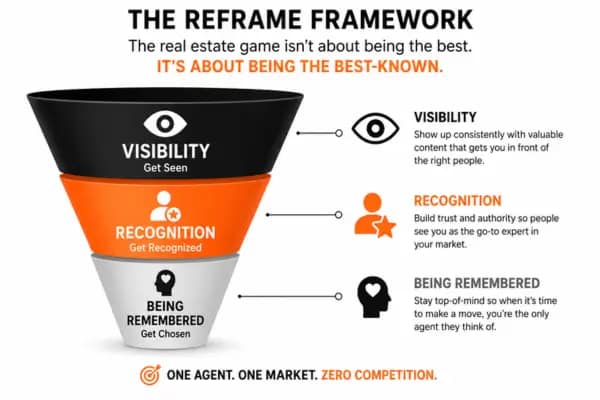
I think about this in three stages: Be Seen. Be Trusted. Be Chosen.™ Be seen is showing up. Be trusted is the market starting to place your face with your market. Be chosen is the point where someone thinks of you specifically, unprompted, the moment they hear a friend is thinking about selling. Most agents stop at be seen and wonder why nothing is converting. Volume without a system produces noise, not recognition, not be chosen. A system without visibility never gets seen at all. You need both, in sequence, held consistently long enough for it to compound.
This is also where most agents quit. Visibility takes roughly two months to start producing any signal at all, which is precisely when most agents give up and conclude it “didn’t work.” That’s not a failure of the strategy. That’s the exact point where the agents who stay start pulling ahead of the ones who leave.
Video-First Visibility, Retargeting, and Presence: How Recognition Actually Gets Built
The mechanism is not complicated, but it has to run in the right order.
Video builds the warm audience. Video is the closest thing available to meeting someone in person before they ever need your services. It carries your voice, your face, and your judgment in a way a listing photo or a bio paragraph cannot. This is the fastest legitimate path to familiarity, which is why local video content consistently outperforms static posts for agents trying to build a market presence from scratch.
A custom audience forms automatically. Every person who watches a meaningful portion of that video has already self-selected. They are not a purchased list of cold strangers. They are real people who chose to pay attention, which puts them in a fundamentally different category than a lead you bought from a portal.
Retargeting keeps you top of mind. You speak to that same warm audience again, consistently, so they keep seeing the same face and hearing the same voice. This is the recognition step compounding. It’s also the piece that separates safe, durable market authority from a temporary bump in engagement that fades the moment you stop posting.
Lead generation happens only with a consistent market presence. This is the part most marketing gets backwards. Leads are offered to people who already trusted you, not to cold traffic. That is why they convert. The relationship exists before the lead form does.
Consistent market presence moves people forward with one clear next step. No pressure, no hype, just a consistent invitation for someone who is already interested to take the next step when they’re ready.
I’ve watched this play out with a new brokerage that entered its market with zero recognition and no track record locally. Structured visibility, built the same way, made them known in their area within a year. The result wasn’t just transactions. It created enough market presence to support recruiting and grow the brokerage itself. That’s what recognition actually buys you: not a single sale, but a market position competitors can’t easily take from you once it’s built. To understand why I built this system, read Why I Do This Work.
The alternative is what most agents are currently doing: interruption marketing aimed at strangers who have no reason to trust them yet. Cold calling and cold lead lists exist specifically because nobody knows who the agent is. That approach doesn’t fail because the tactics are wrong. It fails because it’s solving the wrong problem. Consistency, not any single tactic, is what turns visibility into recognition.
Practical Steps to Fix Your Recognition Problem
- Search yourself the way a stranger would. Before touching your marketing, look yourself up the way someone in your market actually would. If a stranger can’t find recent video content, a real presence, or evidence you’re active locally, neither can they place you as someone they already trust.
- Pick one video format and commit to it for a minimum of 90 days. Not sixty. Momentum typically starts right around month two, which is exactly when most agents quit. Give it the runway before you judge it.
- Build a retargeting audience from the people who already watched. Don’t buy a cold list. Let your video content build the audience, then speak specifically to the people who chose to pay attention.
- Show up as the same person every time. Same face, similar tone, recognizable format. Recognition compounds through repetition, not variety. Novelty resets the clock; consistency builds it.
- Attach one clear next step to every piece of content. A single, low-pressure invitation, not a hard sell and not five competing calls to action.
- Track recognition signals, not just leads. Comments like “I’ve seen you everywhere,” DMs from people you’ve never met, or a referral who says they already felt like they knew you: that’s the metric that tells you the system is working before the transaction data catches up.
- Give the system a real runway before deciding it doesn’t work. Six months minimum. Recognition is not a 48-hour lead promise, and it was never supposed to be.
Frequently Asked Questions About the Real Estate Recognition Problem
What exactly is the real estate recognition problem?
It’s the gap between being a competent agent and being a chosen one. Buyers and sellers can’t easily evaluate agent skill from the outside, so they default to the agent they already recognize. Skilled but invisible agents consistently lose business to less experienced agents who built more visibility.
Why do experienced, competent agents lose clients to newer agents?
Because the market isn’t grading on tenure. It’s grading on familiarity. A newer agent who shows up consistently on video and social media can out-recognize a fifteen-year veteran who has no digital presence, even though the veteran is more qualified on paper.
Will buying more leads fix a recognition problem?
No. More leads means more strangers to introduce yourself to from zero, which is the same position an invisible agent is already stuck in. Recognition converts existing leads better; it doesn’t need volume to work, and volume alone doesn’t create it.
How long does it actually take to build recognition through video?
Most agents see the first real signal around the two-month mark, which is also where most agents quit. A realistic runway is six months of consistent presence before you have enough data to evaluate whether it’s working.
Do I have to be comfortable on camera for this to work?
You need to be willing to show up on camera, not polished on camera. The fear of being judged stops more agents than the camera itself does. Consistency and a real presence beat production value every time.
The Bottom Line
Your next client is going to verify you online before they ever pick up the phone. What they find in that moment is the whole game. A Zillow profile you didn’t build, a Facebook page you haven’t touched since spring, or a video where they hear your voice and start to feel like they already know you: one of those gets the call.
You are not being replaced by a better agent. You are being outrecognized by a more visible one. That’s a fixable problem, but only if you stop treating it like a lead-volume problem and start treating it like what it actually is: a positioning decision.
Position yourself to attract. Stop chasing leads that die on the vine.
Keep Learning
the recognition gap explained through the agents living it right now.
what happens when visibility isn’t maintained.
the recognition gap explained through the agents living it right now.the difference between durable recognition and a temporary spike.
the mechanics of building a warm local audience through video.
why repetition, not any single tactic, is what makes recognition stick.
ABOUT
_____
ANNETT T. BLOCK
Annett T. Block is a real estate marketing strategist and licensed Florida broker. She works with real estate agents who want to stop chasing leads that die on the vine and start attracting business from people who already know them through video-first warm audience building, retargeting, and consistent market presence. She is the founder of The Digital Adopters.
Her thesis is simple: The lead isn’t dead. You asked for the conversation before they knew you.
In real estate since 2008. Licensed Florida broker since 2011. More than 2,000 agents, teams, and brokerages served.
One agent. One market. ZERO COMPETITION.
LICENSED FLORIDA BROKER
IN REAL ESTATE SINCE 2008
More than 2000 AGENTS SERVED
FEATURED IN INMAN NEWS
1 AGENT PER MARKET