

Most agents are using AI. Very few are using it on the workflows that move the needle. Here is the difference.
Most real estate agents are not ignoring AI. They adopted it months ago. They use it to write listing descriptions. They use it to draft social media captions. They paste market data into ChatGPT and get back something that sounds vaguely useful.
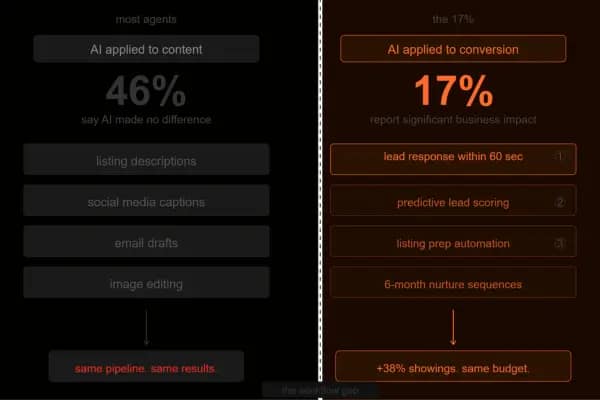
And yet, when NAR surveyed 49,233 active Realtors in 2025, only 17 percent said AI had a significant positive impact on their business. Forty-six percent said it had no noticeable impact at all.
That gap is not a technology problem. It is a workflow problem.
The agents who are seeing real business results from AI are not using more tools. They are using AI on the three specific workflows that directly affect whether a lead becomes a client. Everything else is administrative convenience dressed up as strategy.
This is the difference. And it is worth understanding clearly.
Key Takeaways
- 82% of agents now use AI tools. Only 17% report significant business impact. The gap is workflow design, not adoption.
- AI delivers clear results in three areas: automated lead response, predictive lead scoring, and listing preparation.
- Most agents are applying AI to marketing and content tasks that improve productivity without moving the conversion rate.
- Real estate AI automation workflows that work support the relationship. They do not simulate it.
- The agents falling behind are not the ones who skipped AI. They are the ones who applied it in the wrong places.
Table of Contents
The Problem With How Most Agents Use AI
Here is what most agents are doing with AI.
They write listing descriptions faster. They draft emails in a fraction of the time. They let an AI tool generate three Instagram captions from a single prompt. They feel productive. They feel modern. And then they check their pipeline and wonder why nothing has changed.
The issue is not that these tasks are worthless. It is that they are the wrong tasks to automate first.
Real estate AI automation workflows that actually produce results are built around the moments in a transaction that are most sensitive to time and most vulnerable to human error. Writing a listing description is not one of those moments. Responding to a buyer inquiry at 11 p.m. on a Saturday is.
The agents who are winning in 2026 understand a structural truth the rest of the industry is still working out: AI does not make you better at your business by making your marketing prettier. It makes you better by making your business faster to respond, sharper in its follow-up, and more consistent across a pipeline that used to depend entirely on whether you remembered to send the email.
I have watched agents invest in tools, learn the prompts, and still see nothing change. Not because the tools did not work, but because they pointed them at the easiest tasks instead of the most important ones. That is a common pattern. It is also an expensive one.
Most of the conversation about real estate AI automation focuses on content generation. The agents generating the highest returns are focused on conversion architecture. Those are two different problems. One saves time. The other saves deals.
If you want to understand why your pipeline looks the same despite all the tools you have added, the answer is almost always that AI has been applied at the wrong point in the client journey. The structural breakdown of where most agent pipelines lose momentum is something I cover in detail here: When Your Pipeline Feels Random, It’s Usually Not the Market.
What the Data Shows About Real Estate AI Automation Workflows
The numbers on this topic are unusually specific, and they tell a story the industry has not fully processed yet.
RPR’s February 2026 survey of 225 real estate professionals found that 82 percent of agents now use AI tools in their business. That number was 68 percent in NAR’s July 2025 survey and approximately 15 percent in 2023. The growth curve is steep. The results curve is not keeping pace.
The breakdown of what agents are actually doing with AI explains why. The RPR survey found the top uses are writing listing descriptions (68 percent of respondents), creating social media content (59 percent), and drafting emails or newsletters (53 percent). Image editing came in fourth. Market analysis tools came in fifth.
The uses that most directly affect whether an agent closes a deal. Automated first response to leads, predictive lead scoring, and consistent nurture sequences, ranked far lower.
This is the workflow gap. Agents are applying real estate AI automation tools to the tasks they can see and measure easily. They are not applying them to the moments where the lead decides whether to work with them or move to the next agent.
One solo agent in Atlanta documented what happens when you fix that. After adopting an AI-powered CRM in mid-2025, he built a 12-week automated nurture sequence for every new inquiry and began responding to 62 percent of his leads within 90 seconds, around the clock. His showing bookings increased 38 percent in six months without any change to his lead spend. Same market. Same budget. Different workflow architecture.
The performance gap between that agent and an agent using AI only for content is not a technology gap. It is a decision about where in the business the AI actually goes to work.
A February 2026 study from Pinova confirms this pattern. AI delivers the clearest measurable return in three specific areas: automated first response to leads within 60 seconds, predictive lead scoring that identifies which contacts to call first, and nurture sequences that run for six or more months without requiring ongoing agent input. These are the workflows that protect pipeline. Everything else is margin.
The broader market data supports the urgency here. Global PropTech investment reached $16.7 billion in 2025, a 67.9 percent increase year over year. Agentic AI. Systems capable of executing multi-step real estate workflows with minimal human input, is expected to reach mainstream adoption in 2026 and 2027. Morgan Stanley estimates AI could automate up to 37 percent of real estate operations, representing approximately $34 billion in efficiency gains over the next five years.
The agents who understand this are not waiting to see how it unfolds. They are building the workflows now, while the gap between early adopters and late movers is still closeable. If you are thinking about what an AI-supported visibility system actually looks like in practice, I have outlined that framework on this page: Best Platform For Real Estate Marketing
The industry has a proof gap. JLL found that 92 percent of commercial real estate teams have started piloting AI, but only 5 percent report achieving most of their program goals. The pattern holds across the residential side as well. Widespread adoption. Narrow results. The distance between the two is workflow design.
What Real Estate AI Automation Workflows Actually Look Like When They Work
Agents that are seeing real results from real estate AI automation workflows are concentrating on three specific areas.
The first is lead response. Speed matters more than most agents realize. Research consistently shows that responding to an inbound lead within the first 60 seconds produces dramatically higher conversion rates than responding even 30 minutes later. Most agents cannot do that manually across an active pipeline. AI can. The agents building automated first-response systems are not sacrificing quality. They are protecting the moments where most leads decide whether to keep talking to you or move on.
The second is lead scoring and prioritization. A lead who went quiet six months ago but has opened your last three listing alerts is a different lead than one who has been completely silent. AI follow-up systems can detect that behavioral signal and surface the re-engaged contact for a personal call, while continuing automated nurture on everyone else. That is not automation replacing judgment. That is automation supporting it.
The third is listing preparation. The administrative work between signing the listing agreement and going live on the MLS has always been time-consuming. Comparative market analysis, listing copy, disclosure review, showing feedback synthesis. Each of those tasks is a candidate for AI support. Agents who have built this workflow report compressing hours of preparation into minutes, which means more time at the appointments themselves.
None of this replaces the relationship. The moments in a real estate transaction that actually require human judgment (pricing strategy, negotiation, the emotional support that comes with a major financial decision) are exactly the moments AI cannot handle and should not try to.
The Be Seen, Be Known, Be Trusted, Be Chosen framework applies directly here. AI accelerates the first two stages. It creates conditions for the third. But chosen is still earned by the agent, not the algorithm.
What the framework looks like in practice is not complicated. It is precise application of the right tool at the right point in the client journey. The agents who are waiting to see where AI lands before committing are already behind the agents who made that decision six months ago. The workflow gap is widening. The full context for how this applies to your market is something worth reviewing specifically: Real Estate Training.
Trust cannot be automated. But it can be consistently supported. That distinction is the entire conversation.
Frequently Asked Questions About Real Estate AI Automation Workflows
What real estate AI automation workflows actually produce business results?
The three highest-impact workflows are automated lead response within 60 seconds, predictive lead scoring that identifies which contacts to call first, and listing preparation automation covering CMA drafting, copy, and disclosure review. These directly affect whether a lead converts. Content automation improves productivity but does not reliably move conversion rates.
Is AI going to replace real estate agents?
No. The highest-value moments in a real estate transaction (pricing strategy, negotiation, fiduciary guidance, and emotional support during a major financial decision) are precisely the moments AI handles worst. AI makes agents faster and more consistent. It does not make the human relationship unnecessary. The agents most at risk are those who stop developing the skills AI cannot replicate.
Why are so many agents using AI but not seeing results?
Most agents are applying AI to marketing and content tasks that are visible and easy to measure. Writing listing descriptions, generating social posts, drafting emails. These tasks save time. They do not directly move the conversion needle. The agents seeing results are applying AI to the workflows that control whether a lead becomes a client, response speed, nurture consistency, and lead prioritization.
How do I start building real estate AI automation workflows without overhauling my entire business?
Start with one high-leverage moment. If your biggest gap is response time, build an automated first-response system for new inquiries. If your biggest gap is follow-up consistency, build a six-month nurture sequence in your CRM. The agents seeing the clearest returns started with one workflow and built from there. They did not overhaul everything at once.
What is agentic AI and should real estate agents care about it now?
Agentic AI refers to autonomous systems that execute multi-step workflows with minimal human prompting. Tenant onboarding, lead qualification, transaction management. Analysts expect it to reach mainstream use in real estate between 2026 and 2027. Agents who understand workflow architecture now will be better positioned to adopt these systems when they become accessible. The foundation is understanding which workflows to automate. The tools become easier to evaluate once that is clear.
Final Thought
Eighty-two percent of agents are using AI. Forty-six percent say it has made no difference to their business.
That is not a technology indictment. The tools work. The problem is placement. Most agents adopted AI at the visible layer of their business, where outputs are easy to see and feel productive. Social posts. Listing descriptions. Email drafts. What they did not do is audit the invisible layer, where leads fall silent, where response speed determines outcomes, and where follow-up consistency determines whether a six-month-old contact ever converts.
The workflow gap in this industry is not closing on its own. The agents who are already three or four months into rebuilding their pipeline architecture around AI are compounding the advantage every day. The agents still applying AI to content and wondering why the pipeline looks the same are not running out of time, but they are closer to that point than they think.
AI does not replace what makes a great agent. It protects the moments where a great agent would otherwise drop the ball because they are human and busy and managing too much at once.
If you want to understand specifically where your pipeline is breaking down and what a workflow built to address it would look like, that is exactly what I cover in a Market Availability Review. One conversation. Specific to your market. No obligation.
Book your Market Availability Review here.
The pipeline does not fix itself. The workflow does.
About the Author: Annett T. Block is a U.S. Business Broker and Real Estate Marketing Strategist specializing in video-first authority, paid distribution, retargeting architecture, and AI-supported visibility workflows for established real estate professionals.
Reference Resources
AI in Real Estate 2026: Source for PropTech investment figures, agentic AI timeline, and the 70% junior task automation projection.
How Top Producers Are Using AI Without Losing the Personal Touch: Source for the Atlanta agent case study and the three-workflow framework (intake, follow-up, listing prep).
AI Agents Real Estate Workflow Automation 2026: Source for Morgan Stanley $34 billion efficiency estimate and Delta Media adoption data.
Related Posts



Author Annett T. Block
Annett T. Block is a real estate marketing strategist and licensed Florida broker. She works with real estate agents who want to stop chasing leads that die on the vine and start attracting business from people who already know them through video-first warm audience building, retargeting, and consistent market presence. She is the founder of The Digital Adopters.
Her thesis is simple: The lead isn’t dead. You asked for the conversation before they knew you.
One agent. One market. ZERO COMPETITION.
In real estate since 2008. Licensed Florida Broker since 2011. More than 2,000 agents, teams, and brokerages served. Featured in Inman News. She is the author of From Listings to Legends.